
Legal search is hyper-local and high-trust at the same time: a personal injury search in one city has nothing to do with rankings in the next, and every page needs the credibility signals bar associations and Google both expect. Most SEO strategies treat law firms like any other local business, or any other YMYL content, but never solve for both at once. We build legal SEO that handles the local architecture and the trust signals together.
TRUSTED BY GROWTH-STAGE COMPANIES









THE LEGAL SEO PROBLEM
Most law firms run an SEO strategy that’s either generic local SEO or generic content SEO, and never one tuned for how legal clients actually search. Here’s what’s silently costing you rankings and cases every month.
“Personal injury lawyer near me” and “divorce attorney in [city]” are searched constantly, and if your Google Business Profile and local signals aren't built for legal specifically, competitors with worse case results outrank you.
Bar admission, case results, and practice area credentials all feed into how Google evaluates legal content's trustworthiness: generic “meet our team” bios rarely include the signals that actually matter.
Near-identical location pages across offices read as duplicate content to Google, splitting rankings across every city you operate in instead of building authority in each.
Case results, testimonials, and outcome claims are some of the most persuasive, and most tightly regulated, content types in legal marketing. Most SEO strategies don't account for what bar rules actually allow.
of local legal searches include “near me” or a specific city
to establish local map pack and attorney E-E-A-T signals
average increase in map pack visibility for multi-location firms
best-case growth in organic-driven case inquiries
The standard SEO playbook treats local SEO and YMYL content as separate problems. Legal search requires solving both simultaneously: every practice area page needs to rank locally and demonstrate real legal authority.
Legal search is overwhelmingly local, practice-area specific
Clients rarely search for “lawyer”: they search for “car accident lawyer in [city]” or “estate planning attorney near me.” Generic local SEO misses the practice-area layer; generic content SEO misses the local layer.
Attorney and firm credibility signals carry real ranking weight
Bar admission, years of practice, case results, and named attorney authorship all feed into Google's evaluation of legal content: the same E-E-A-T mechanics as other YMYL categories, applied to legal expertise specifically.
Bar advertising rules constrain what content can say
Case results and testimonial content are heavily regulated by state bar associations. We build content and local strategies that work within those rules rather than around them.
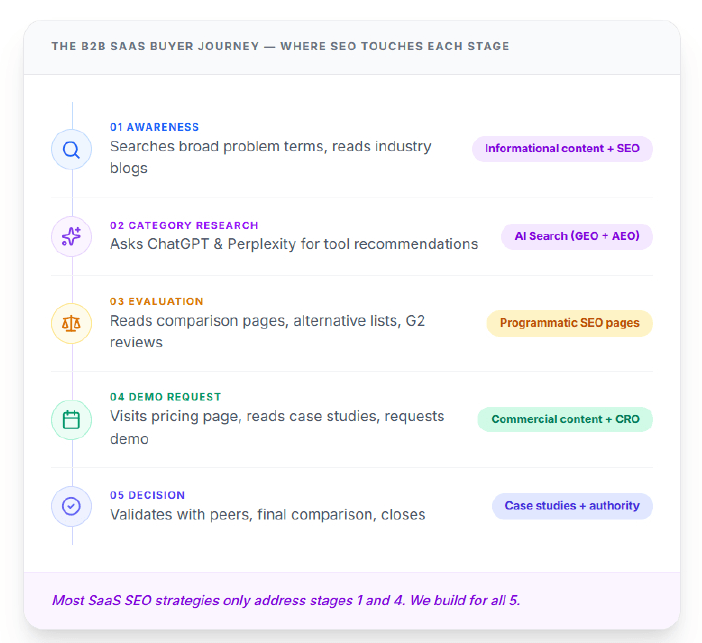
Every service is applied through the lens of local search and legal E-E-A-T. Client inquiries are the output.
PILLAR 01 · AI & FUTURE SEARCH
Prospective clients increasingly ask ChatGPT and Google AI “who’s a good [practice area] lawyer in [city]” before searching Google directly. We build the entity and local authority signals that get your firm cited, not just crawled.
PILLAR 02 · CORE SEO
Every office needs its own local visibility, without location pages competing against each other or against the firm’s core site. We build the local architecture that scales across offices correctly.
PILLAR 03 · CONTENT & AUTHORITY
We build attorney bios and practice area pages that include the specific credibility signals Google evaluates for legal content: bar admission, case results (within advertising rules), and named authorship.
PILLAR 04 · CONTENT & AUTHORITY
Firms with multiple practice areas and multiple offices need content that scales without becoming thin or duplicate across combinations. We build the template structure that avoids that trap.
PILLAR 05 · CONTENT & AUTHORITY
Legal directory presence, press mentions, and professional recognition all reinforce the trust signals that support both rankings and genuine client confidence.
PILLAR 06 · AUDIT & INTELLIGENCE
Everything above rolls into one roadmap, sequenced by which fixes move local visibility and legal credibility fastest, broken out per office if you operate more than one location.
LEGAL · MULTI-LOCATION
Organic-driven case inquiries in 7 months
“A 4-office personal injury firm had location pages that were nearly identical copies of each other. Google treated them as duplicates and none of them ranked well. After rebuilding each location’s content and attorney bios around real local and E-E-A-T signals, all four offices started ranking in their local map packs.”

Questions we actually get from managing partners and marketing leads every week.
No. Multi-location SEO only applies if you operate more than one office. Single-location firms still need the local and E-E-A-T signals covered in this audit, just without the location-page architecture layer.
We structure and advise on presentation: the specific language around case results and testimonials needs to comply with your state bar's advertising rules, which your firm or legal counsel should review before publishing. We work within those constraints, not around them.
Generic local SEO doesn't account for practice-area-specific search behaviour or the E-E-A-T signals Google applies to legal content specifically. We combine both, rather than treating them as separate problems.
Being listed and being consistently, accurately listed are different things. Most firms we audit have NAP inconsistencies or outdated information across these directories that quietly undermines local trust signals.
Typically 6–10 weeks for initial local and E-E-A-T signal improvements, with fuller map pack and organic movement building over several months.
Based on number of offices, practice areas, and current site complexity. You'll get a clear number before anything starts.
Different industries need different SEO approaches. Find the page built for your specific context.
FINTECH & FINANCIAL
E-E-A-T, YMYL, trust signals, and financial product schema: the SEO layer regulated industries need but most agencies can’t deliver.
HEALTHTECH & HEALTH
YMYL compliance, medical structured data, clinical credibility signals, and the E-E-A-T requirements that determine whether health content ranks.
B2B SaaS & AI
React/Next.js technical challenges, AI search visibility, and pipeline-connected reporting for growth-stage software companies.
Book a free 20-minute discovery call. We’ll look at your site, identify the most likely local and E-E-A-T gaps affecting your rankings, and tell you honestly whether we’re the right team for your situation.