
You’re building something real. Every SaaS company we talk to has an SEO strategy built for search volume, not for the buyers actively evaluating tools in your category. That’s exactly what the SEO industry consistently fails to deliver: a clear, prioritised starting point, with honest answers about what to do first and what to ignore entirely.
TRUSTED BY GROWTH-STAGE COMPANIES









THE B2B SAAS SEO PROBLEM
You rank for informational keywords that attract the wrong audience. The visitors who land don't match your ICP-and your content isn't built around the buyer journey stages where demos actually happen.
A product with half your features, less funding, and lower G2 ratings sits above you in the SERPs you care about. The difference is rarely the product it's the SEO architecture and content strategy behind it.
Buyers now use ChatGPT, Perplexity, and Google AI Overviews to research and shortlist SaaS tools before they open a comparison page. If your entity isn't established, you're not on the shortlist before the evaluation even starts.
Your analytics say organic brings traffic. Your CRM says demos come from 'direct.' No one knows which organic content is actually driving pipeline, so you can't invest more in what's working or cut what isn't.
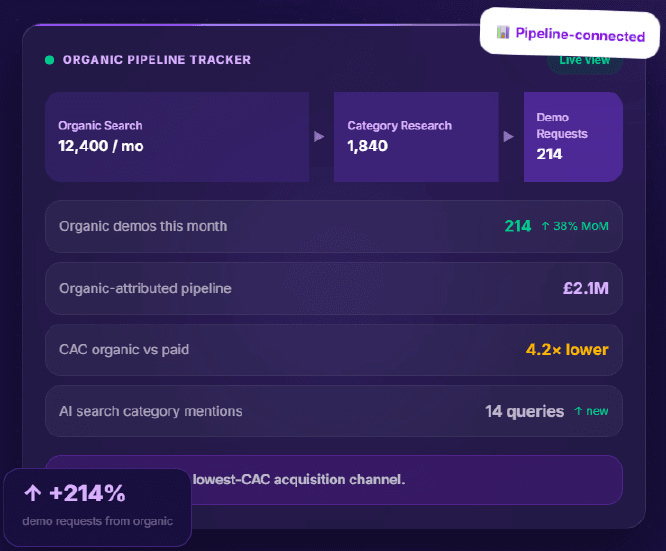
increase in demo requests for Series B SaaS client after 11 months
organic pipeline influenced in a single SaaS engagement
lower customer acquisition cost from organic vs paid for SaaS clients
of all demo requests now from organic -up from near zero
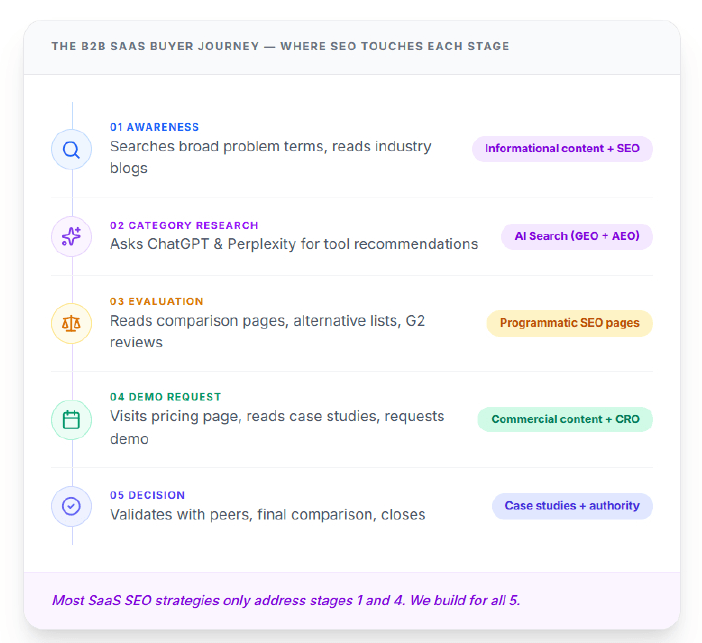
The standard SEO playbook is built around transactional keywords and volume. B2B SaaS buyers research across 4-8 touchpoints before requesting a demo – and most of those touchpoints have nothing to do with your highest-volume keywords. Your SEO strategy needs to match how they actually buy.
The buyer journey is 4-8 touchpoints long
A B2B SaaS buyer sees comparison articles, Reddit threads, G2 reviews, and Al responses before your pricing page. Your SEO must be present across every stage - not just the high-volume head terms.
Al is changing the shortlisting process
Buyers now ask ChatGPT 'what's the best tool for X' before they open Google. Being cited in Al responses for your category requires a different set of SEO signals - entity authority, structured data, AEO content.
SaaS sites have unique technical SEO challenges
React and Next.js apps, app vs marketing site separation, dynamic content, rapid feature releases creating crawl debt - these require specialist technical SEO knowledge most generalist agencies don't have.
PILLAR 01 · AI & FUTURE SEARCH
Buyers now ask ChatGPT and Perplexity “what’s the best tool for X” before they ever open Google. We build the entity authority and structured content that gets your product cited in AI tool recommendations, not just crawled.
PILLAR 02 · CORE SEO
SaaS sites have unique challenges: app/marketing site separation, JavaScript rendering, dynamic content indexation, and rapid feature releases creating crawl debt. We solve the technical issues specific to SaaS.
PILLAR 03 · CONTENT & AUTHORITY
Most SaaS content targets high-volume, top-of-funnel keywords that never convert to demos. We map content to the 4–8 touchpoints your actual buyers move through, so commercial-intent stages aren’t left empty.
PILLAR 03 · CONTENT & AUTHORITY
“Best tool for X” and “[Competitor] alternatives” pages are some of the highest-converting real estate in SaaS SEO. We build these programmatically without triggering the thin-content risk most SaaS teams hit.
PILLAR 03 · CONTENT & AUTHORITY
G2 ratings, review site presence, and category mentions all feed into whether AI models and buyers see you as a real player. We build the authority signals that support both traditional rankings and AI citation.
PILLAR 04 · AUDIT & INTELLIGENCE
Everything above rolls into one roadmap, sequenced by pipeline impact and mapped to your buyer journey stages, so you know exactly which stage to fix first.
“A Series B project management SaaS had 0 organic demos. Not a few-zero. Their agency was sending monthly traffic reports showing growth. Nobody had connected sessions to demo conversions. After a technical SEO audit, programmatic integration pages, and an Al search strategy organic became their lowest-CAC acquisition channel within the year.”

This is the most common B2B SaaS SEO problem we see. It almost always means your content is attracting the wrong audience - or the right audience at the wrong stage. Growing traffic from informational keywords while your commercial-intent pages underperform is a content strategy problem, not a traffic problem. A content audit mapped against your buyer journey stages usually identifies the disconnect within a week.
In SaaS specifically, it's rarely about content volume. It's usually SEO architecture and technical execution. A competitor with fewer features and lower G2 ratings can still outrank you if their site structure, page speed, and content-to-intent match are simply better executed. We isolate exactly which factor is doing the damage.
Tools flag technical issues generically: they don't know that your React app's rendering setup is burning crawl budget, or that your pricing page competes with three other pages for the same keyword. We interpret findings specifically for SaaS architecture and buyer behaviour, not just generic SEO best practice.
Not every SaaS company is ready for SEO investment. If you don't have product-market fit yet, or your buyer journey is still changing rapidly, paid channels often make more sense short-term. We'll tell you honestly if organic isn't the priority yet.
Technical fixes can show movement in 4–8 weeks. Content and authority-driven pipeline growth, the kind reflected in the case study above, typically takes 6–12 months to fully compound, though partial gains often show earlier.
The audit and roadmap are a one-time engagement. Whether you need ongoing support depends on your internal team's capacity to execute: some clients handle implementation themselves, others bring us back for execution support.
FINTECH & FINANCIAL
HEALTHTECH & HEALTH
LEGAL & PROFESSIONAL