
Weekly blog posts, a content calendar, maybe even a full-time writer, yet rankings still aren’t moving the way they should. More content isn’t the fix if the strategy underneath it is broken. We audit what you’ve already built and tell you what’s actually working.
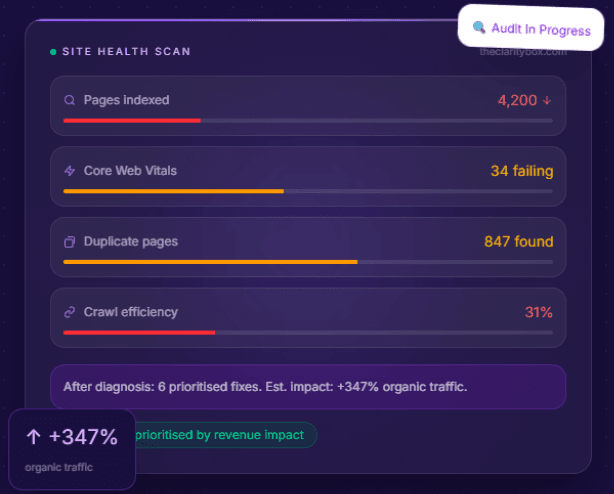
TRUSTED BY GROWTH-STAGE COMPANIES










THE CONTENT VOLUME PROBLEM
More blog posts won’t fix a content strategy problem. They just make the problem bigger.
Two blog posts targeting the same keyword split rankings instead of building on each other, and nobody noticed until neither one ranks.
A pile of disconnected posts with no semantic relationship between them reads as noise to search engines, not the depth that earns topical trust.
Posts that ranked well two years ago are losing ground month over month, and without anyone tracking content decay, nobody notices until the traffic's already gone.
Topics chosen by what feels relevant instead of what your buyers are actually typing into search, so the content exists but the demand for it doesn't.
of published web content gets little to no organic search traffic
to complete a full content audit and roadmap
average traffic increase to existing content after refresh & restructure
best-case growth in content-driven organic traffic
Most content audits end with “publish more.” We start by figuring out whether your existing content is actually built to compound, and more often than you’d expect, the fix is consolidating, restructuring, or cutting before anyone writes another word.
Every content decision tied to search demand and business value, not just topic ideas
Existing content assessed for consolidation and refresh before new content gets greenlit
Topic clusters built to reinforce each other, not compete
A publishing plan sized to what your team can actually sustain
Content SEO is multi-dimensional. We audit every layer, not just “what should we write next.”
DIAGNOSTIC LAYER 01
We catalogue every piece of content against real performance data (traffic, rankings, and decay) to separate what’s compounding from what’s quietly costing you crawl budget and topical focus.
DIAGNOSTIC LAYER 02
We map your content into topic clusters and identify where semantic relationships are missing: the structure that tells search engines you have real depth, not just volume.
DIAGNOSTIC LAYER 03
Multiple pages targeting the same keyword and intent split rankings instead of combining strength. We identify every instance and build a consolidation plan.
DIAGNOSTIC LAYER 04
We compare your content topics against real search demand and buyer questions to find where you’re covering the wrong things, or missing the right ones entirely.
DIAGNOSTIC LAYER 05
Thin, generic content underperforms even with perfect keyword targeting. We assess whether your content demonstrates the experience and expertise search engines increasingly reward.
DIAGNOSTIC LAYER 06
Everything above rolls into one roadmap: separating what to refresh, what to consolidate, what to cut, and what genuinely needs to be created, sequenced by impact.
We’d rather tell you now than take your money and find out later
Still Not Sure? Book a Free Call
B2B SaaS · Series A
organic traffic from existing content, 7 months, B2B SaaS company (mostly refresh)

FinTech · Series A
traffic to previously stagnant content, 5 months, ecommerce brand

LegalTech · Series A
reduction in keyword cannibalisation across blog, 4 months, EdTech company


Sometimes, yes: at least temporarily. If half your existing content is cannibalising itself or decaying unnoticed, fixing that usually moves the needle faster than adding more content on top of the problem.
We can, depending on scope, but the audit itself is diagnosis and strategy first. Many clients bring their existing writers up to speed with our briefs rather than needing us to write everything.
It's when a page that used to rank well gradually loses position, often from outdated information, a stronger competitor, or shifting search intent. Left unnoticed, it quietly erodes traffic that took months to earn.
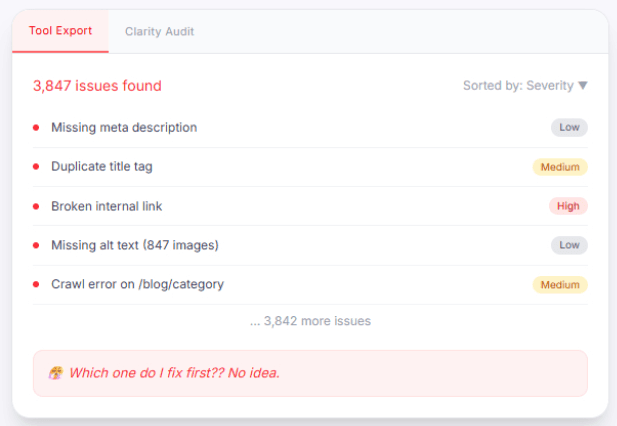
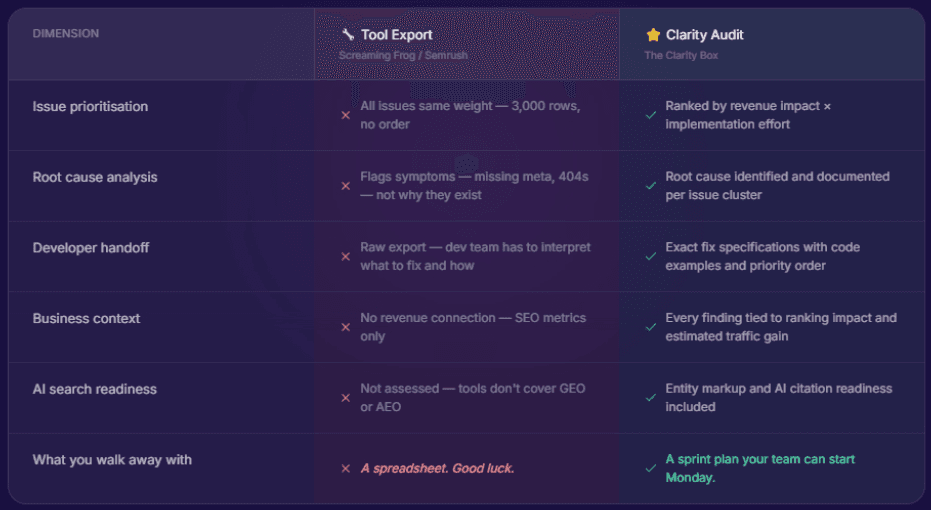
Tools flag metrics. We tell you what those metrics mean for your specific business: which pages to merge, which to kill, which to prioritise refreshing first, and why.
Refreshing and consolidating existing content tends to show movement faster (5–9 weeks) than new content, which still needs time to be crawled, indexed, and trusted.
Based on the size of your existing content library and the complexity of the audit. You'll get a clear number before anything starts.
AUDIT & INTELLIGENCE FLAGSHIP
The complete diagnostic: technical, content, authority, and AI search readiness in one engagement.
CORE SEO PILLAR 01
Earns the authority signals that let strong content actually rank.
AI & FUTURE SEARCH PILLAR 02
For scaling content systematically once the strategy is proven.
One call. No pitch deck. Just a straight answer on what to fix before you write another word.