
You’re managing technical debt from three years of uncoordinated changes, three teams all touching SEO with no shared strategy, and an international expansion that turned hreflang into a liability. Most SEO partners want to start with the basics. We start where you actually are.
TRUSTED BY GROWTH-STAGE COMPANIES










These are the exact conversations we have with enterprise SEO leaders every week. If you’ve thought any of these, you’re in the right place.
“We have technical debt from three different site migrations. Nobody fully understands what’s broken anymore.”
“Three teams touch SEO (product, content, and growth) and none of them talk to each other. We’re actively working against ourselves.”
“We expanded into five markets in eighteen months. Our hreflang implementation is a disaster and I don’t fully trust our own international data.”
“Every agency pitch starts with ‘let’s talk about keyword research.’ We did that five years ago. I need someone who can go deeper on day one.”
“AI search is changing our category faster than our roadmap can keep up. Nobody on my team has a real plan for it.”
“I know exactly what’s wrong with our SEO. What I don’t have is the bandwidth or executive buy-in to fix it. I need a partner who can operate at that level.”
These aren’t signs you need SEO education. They’re signs you need a partner who can operate at your level of complexity from the first conversation. That’s exactly who we work with.
average number of disconnected teams touching SEO at the enterprises we work with
priorities per engagement. Not a 400-item backlog.
from diagnostic to full cross-team alignment
average increase in organic revenue post-engagement
Most SEO playbooks assume one team, one site, one market. You have multiple teams, years of technical debt, and an expansion strategy that outpaced your technical foundation. Generic advice doesn’t survive contact with your actual complexity.
The problem usually isn't a lack of SEO activity: it's that multiple teams are executing without a shared strategy, sometimes actively working against each other. You need a unifying layer, not another team doing more of the same.
Years of migrations, redesigns, and international expansion leave a trail most teams have lost track of. We diagnose the actual current state, not what the documentation says it should be.
You don't need someone explaining what a canonical tag is. You need someone who can discuss crawl budget allocation, cross-market cannibalisation, and AI entity strategy in the first meeting.
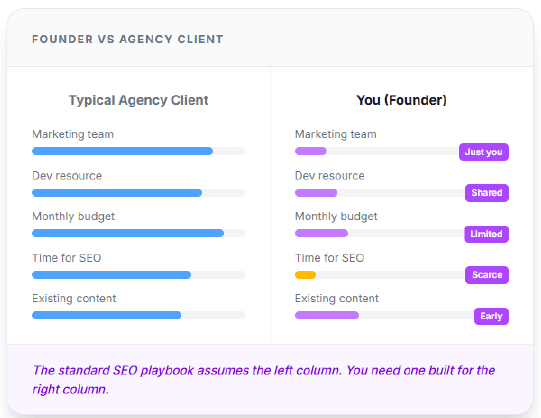
Not every SEO service makes sense at enterprise scale, in this order. Here’s what we recommend, what we don’t, and why.
Stabilise your current markets' technical foundation before adding new ones.
Often the gap is coordination and strategy, not headcount, so it's worth confirming before hiring.
Rarely necessary. Most “we need to rebuild the site” instincts are solving the wrong problem.
Not sure which column you’re in? That’s exactly what a strategic call figures out. No pitch, just an honest read on where you actually stand.
A structured engagement built for organisational complexity, not a generic timeline.
WEEKS 1–2
We talk to you and the other teams touching SEO to understand the actual current state, not just what’s documented.
WEEKS 2–5
Complete technical, content, authority, competitive, and AI search diagnostic across your full site and market footprint.
WEEKS 5–7
A single prioritised roadmap every team can work from, with clear ownership and sequencing.
WEEKS 8–16+
Fixes implemented across teams, with an ongoing governance framework so misalignment doesn’t creep back in.
Engagement scope and duration depends on organisational complexity: we’ll give you an honest estimate specific to your situation, not a generic timeline.
ENTERPRISE SAAS · SERIES D+
3.1x
Organic revenue in 14 months
“A 600-person SaaS company had three teams independently running SEO initiatives, years of unresolved technical debt from two site migrations, and an international footprint with broken hreflang across six markets. We built a single technical and strategic roadmap, established cross-team governance, and fixed the international architecture. Organic became a coordinated, board-visible growth channel for the first time in the company’s history.”

No vague answers. If we don’t know something specific to your situation, we’ll say that too.
Most enterprise engagements aren't about replacing your team: they're about giving them an independent, senior-level diagnostic and strategic layer that's hard to build internally while also executing day-to-day. We often work alongside in-house teams rather than instead of them.
We map stakeholders and ownership as part of the initial diagnostic, then build the roadmap around clear ownership per team rather than a single document nobody actually implements.
Not necessarily: we'll tell you honestly if that's actually the right move or if it's solving a problem that a more targeted technical fix would resolve for a fraction of the cost and disruption.
Yes. We scope every technical recommendation around your actual infrastructure and constraints, not a theoretical clean-slate implementation.
The diagnostic phase is usually 5–7 weeks; full cross-team alignment and initial execution typically takes 3–6 months depending on organisational complexity. We'll give you a specific estimate after the initial strategic call.
Based on site complexity, number of markets, and organisational scope. Enterprise engagements are scoped individually: you'll get a specific proposal after the initial diagnostic conversation, not a generic package price.
Different stages need different SEO approaches. Find the page built for your situation.
Pre-seed to Seed · 1–15 people
Getting SEO right from day one without burning cash or making expensive mistakes.
Series A–B · 15–150 people
Scaling organic as a predictable, board-ready revenue channel with clear attribution.
Digital agencies & consultancies
Specialist SEO depth delivered invisibly under your brand. Your clients. Our expertise. Your secret weapon.
Book a free strategic call. We’ll talk through your actual situation (technical debt, team structure, market footprint) and tell you honestly whether a full diagnostic makes sense. No generic pitch, no SEO 101.