How HVAC companies can set up their Google service area, build service pages before the season and plan for peak demand, with Local Services Ads eligibility.

SEO & Growth Strategist · 10+ years experience
Share this article
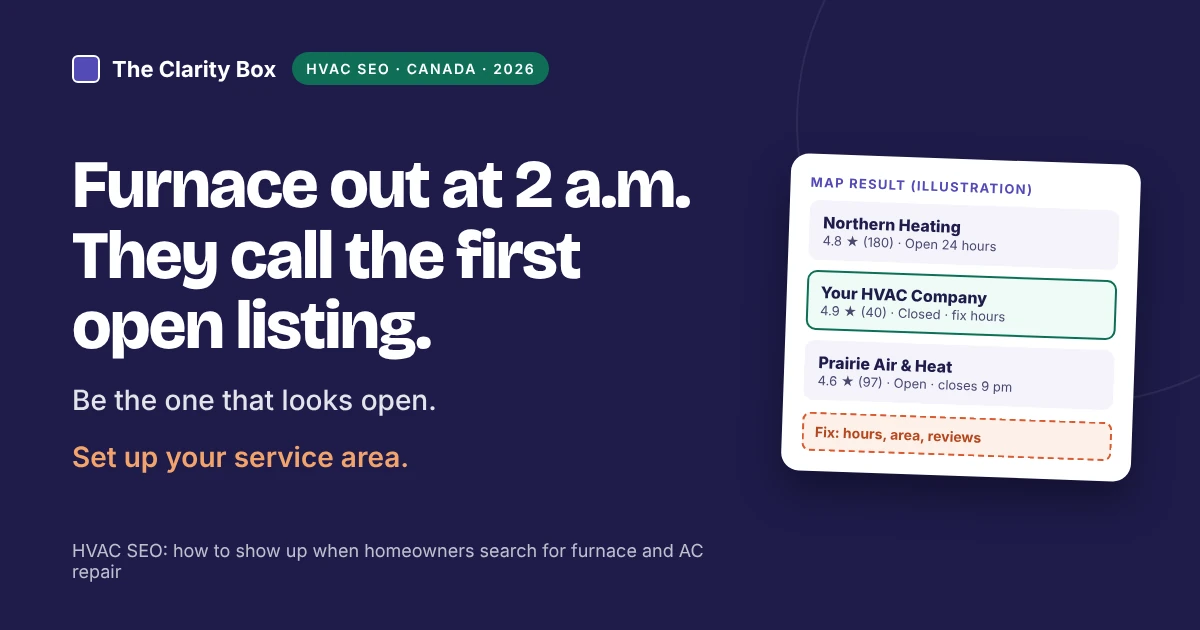
When the furnace stops at 2 a.m., a homeowner calls the first listing that looks open and close by. This guide covers how to be that listing. As of November 13, 2026.
Key takeaways
Demand for heating and cooling repair spikes with the weather. The person searching is not browsing. They are looking at the map result, checking which companies are open now, glancing at ratings, and tapping call. Companies that are closed in the listing, show the wrong hours, or have only a few reviews get skipped.
BrightLocal’s Local Consumer Review Survey 2026 (1,002 U.S. adults, published February 11, 2026) found that 97% read reviews for local businesses and 68% require a rating of four stars or higher. That sample is American and not specific to HVAC, so treat it as direction.
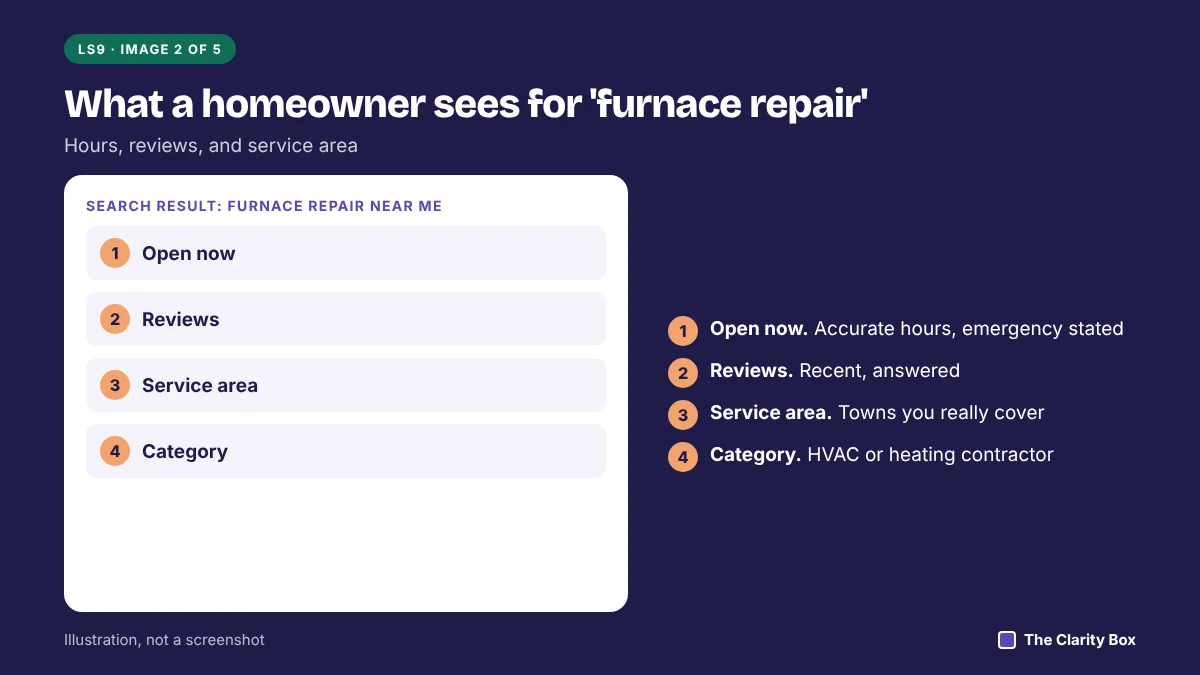
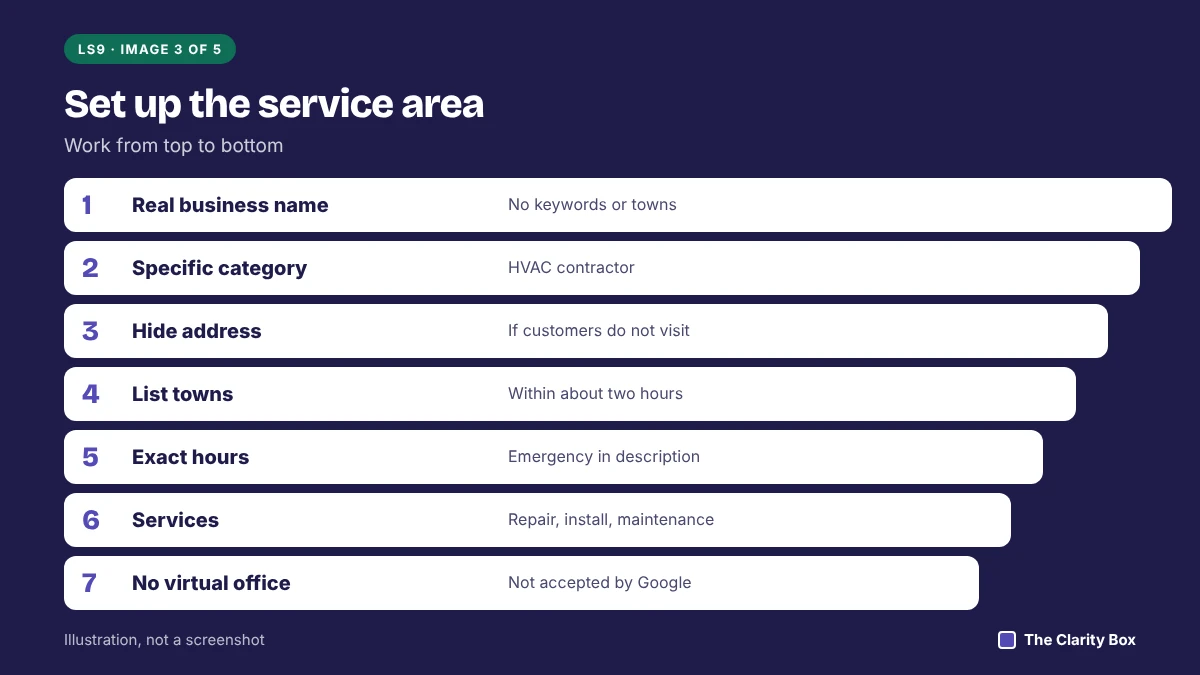
Most HVAC companies travel to customers. Google’s guidelines for service-area businesses say you can hide your address if customers do not visit you and then list the areas you serve. They describe a service area as the places you can reach within roughly two hours of driving. Keep yours honest: listing towns you do not actually cover can lead to suspension. Our guide to ranking a service-area business goes deeper.
| Page | What it must say | Check |
|---|---|---|
| Furnace repair | Common problems, what a visit involves, emergency options, brands you service | Search “furnace repair [town]” and see which page appears |
| AC repair | Same structure, plus summer availability | Same |
| Replacement and installation | How to decide between repair and replacement, the steps of an install, warranties | Read it as a homeowner |
| Maintenance plans | What a visit includes and how often | Compare with your service list |
| One page per main town | Real details: neighborhoods, response area, local jobs | Is there anything on it that is not copied from the next town’s page? |
| Reviews and projects | Photos and short descriptions of real jobs | Do they name the town, with the homeowner’s consent? |
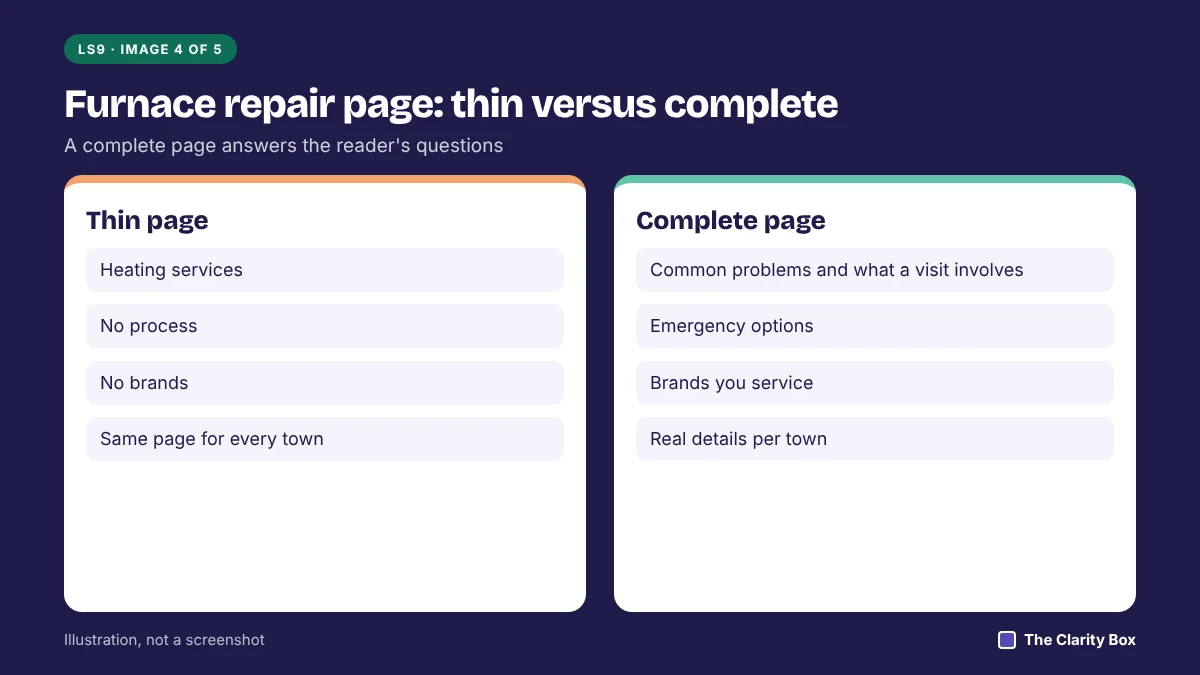
Write each page from your own work. Duplicate pages with only the town name changed are treated as low-value, scaled content in Google’s spam policies.
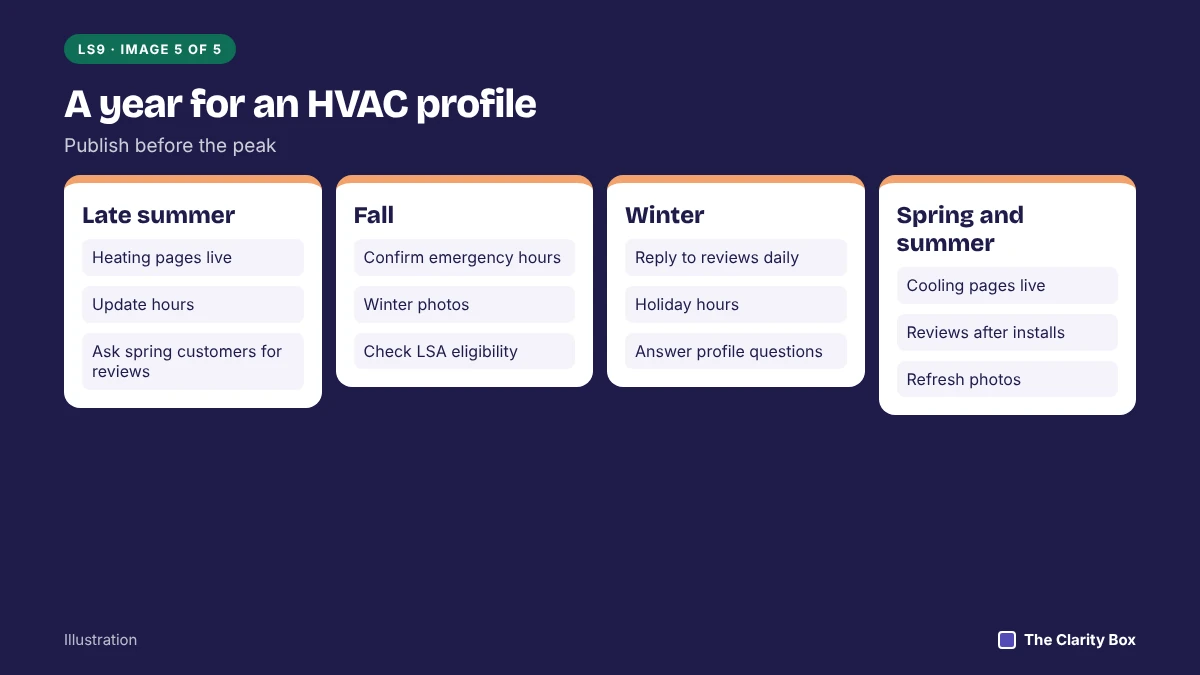
Google’s Local Services Ads list Canada among supported countries and include categories such as HVAC, plumbers, electricians, roofers, real estate services, lawyers, and dentists. Whether you can run them depends on your area and a screening process. Check eligibility in Google’s own tool, then compare paid and organic on speed, control, and risk, not on fees: paid starts fast and stops when you stop, while organic builds more slowly and keeps working. Our answer on how long local SEO takes helps set expectations.
On the first page of google.ca (Canada-targeted results, not city-level, checked November 2026), many results are short articles or agency pages that do not cover service-area settings and give numbers without sources. This guide covers the service-area setup, the page set, the seasonal plan, and Local Services Ads eligibility, and dates every source. For the wider picture, see local SEO and SEO for home service businesses. Contractors in other trades may prefer SEO for contractors.
If customers do not visit you, yes, per Google’s service-area guidance.
Only those you can serve, within the roughly two-hour guideline.
Only for towns you serve and can say something real about.
Check eligibility first, then compare them on speed and control.
Ask at the end of every job, by text, with a direct link.
Profile fixes can show within weeks; pages and reviews take months.
Want the profile, service area, and pages checked before the next cold snap? THE CLARITY BOX will send a written list of what to fix first.
Saba is an SEO and growth strategist with over 10 years of experience in SEO, content strategy, and digital marketing. She writes about organic growth, content optimization, technical SEO, and AI-powered search, translating complex concepts into practical, data-informed insights that help businesses make smarter marketing decisions.