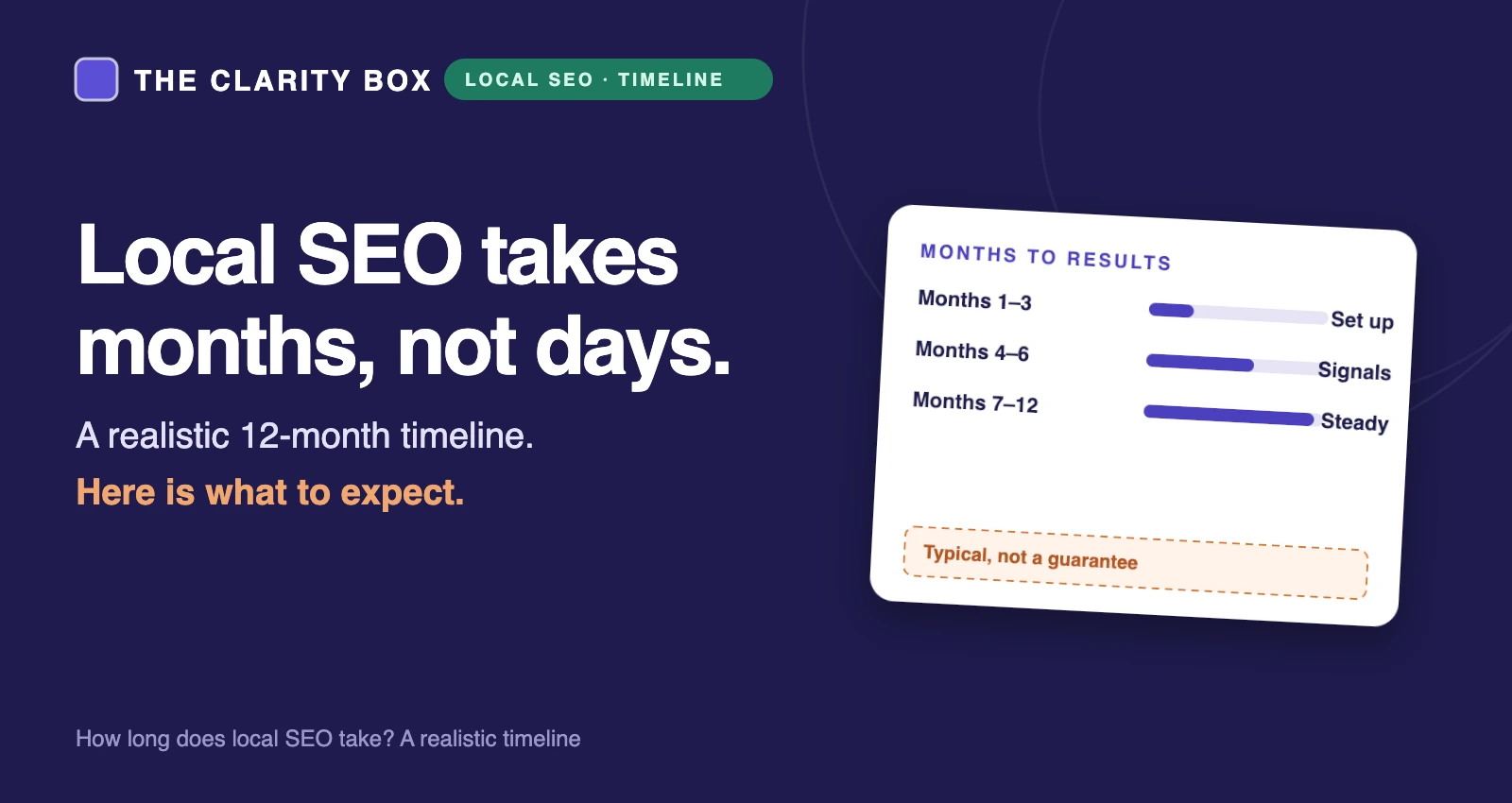
Local SEO usually shows early signals in 1–3 months and steadier enquiries from 4–6. Here is a realistic 12-month timeline, what to measure and what slows it down.

SEO & Growth Strategist · 10+ years experience
Share this article
Ask any local SEO team how long it takes and you will hear “it depends”. This guide turns that into something you can use: a realistic timeline for the first twelve months, what to measure at each stage, and how to tell whether you are on a fast or slow track.
Key takeaways
Plan for three to six months before you see a clear change in calls, direction requests or form enquiries, and six to twelve months before the work is running at full strength. These are typical ranges, not guarantees. A business in a quiet town with a clean Google Business Profile can move sooner. A new profile competing in Toronto or Vancouver against established firms can take longer.
The answer is a range because local SEO is several things running on different clocks: your Google Business Profile, your website, your reviews, and the signals around you such as listings and local mentions. Each moves at its own speed, and where you land depends on how strong your competitors already are.
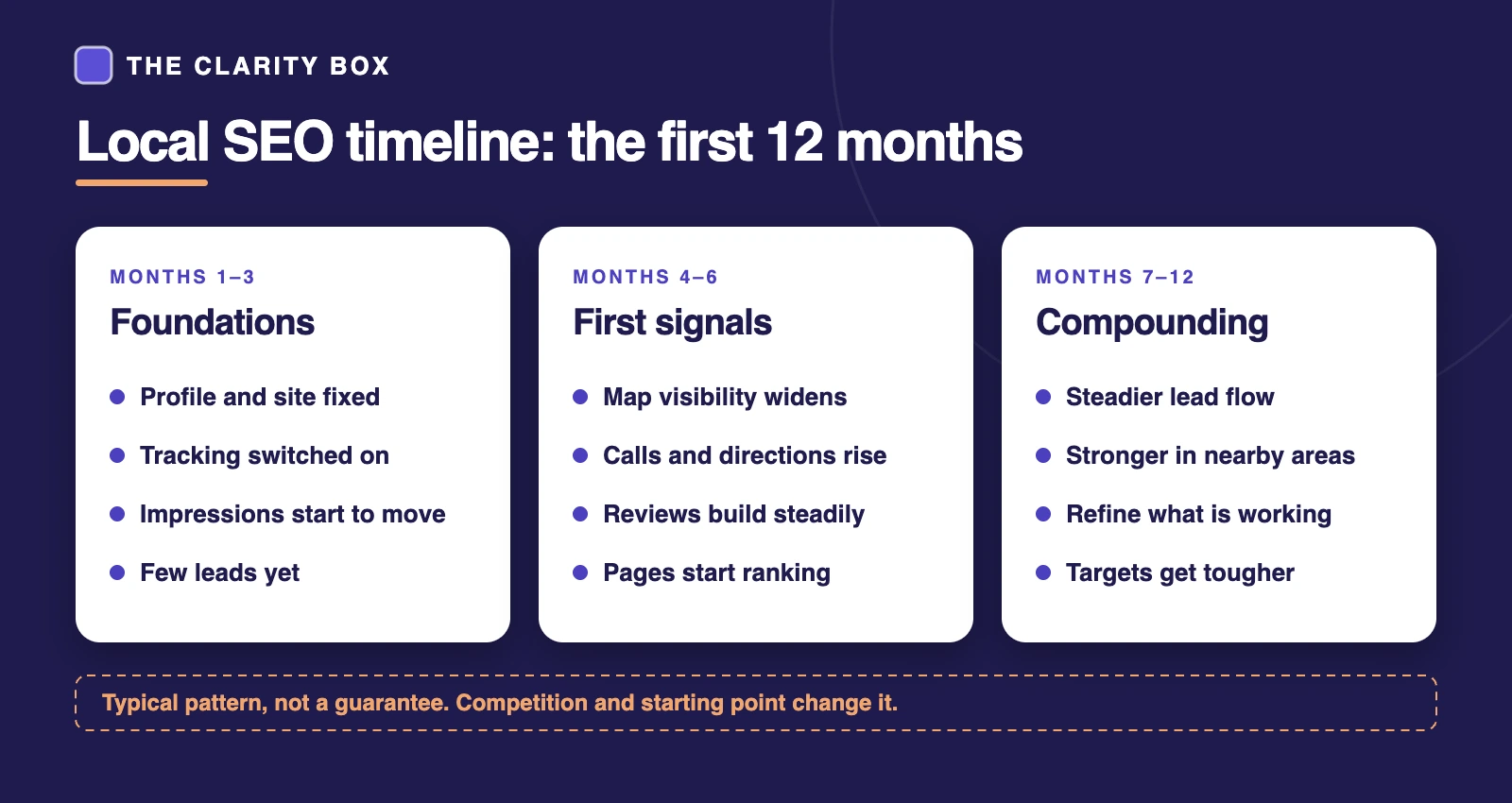
This is the foundation stage. Expect work first and leads later. The usual jobs are:
What you may see: more impressions on your profile and a few new search terms appearing in Search Console. What you should not expect is a steady stream of new customers. If someone promises that in month one, ask for evidence.
This is when most owners first notice a difference. The pattern we would expect to see:
Rankings may still bounce around. Local results change with the searcher’s location, so checking from your own desk is not a reliable test. Use a location-based rank check or your profile’s own performance figures instead.
Gains start to compound. Lead flow becomes steadier, you become visible in neighbouring suburbs, and you can see which pages and services actually produce enquiries and put more effort there. Competitors also respond, so the targets get tougher and the work shifts to review flow, fresh photos, new service pages and tracking. Local businesses are also increasingly named in AI-generated answers, which is covered in our guide to AI search visibility.
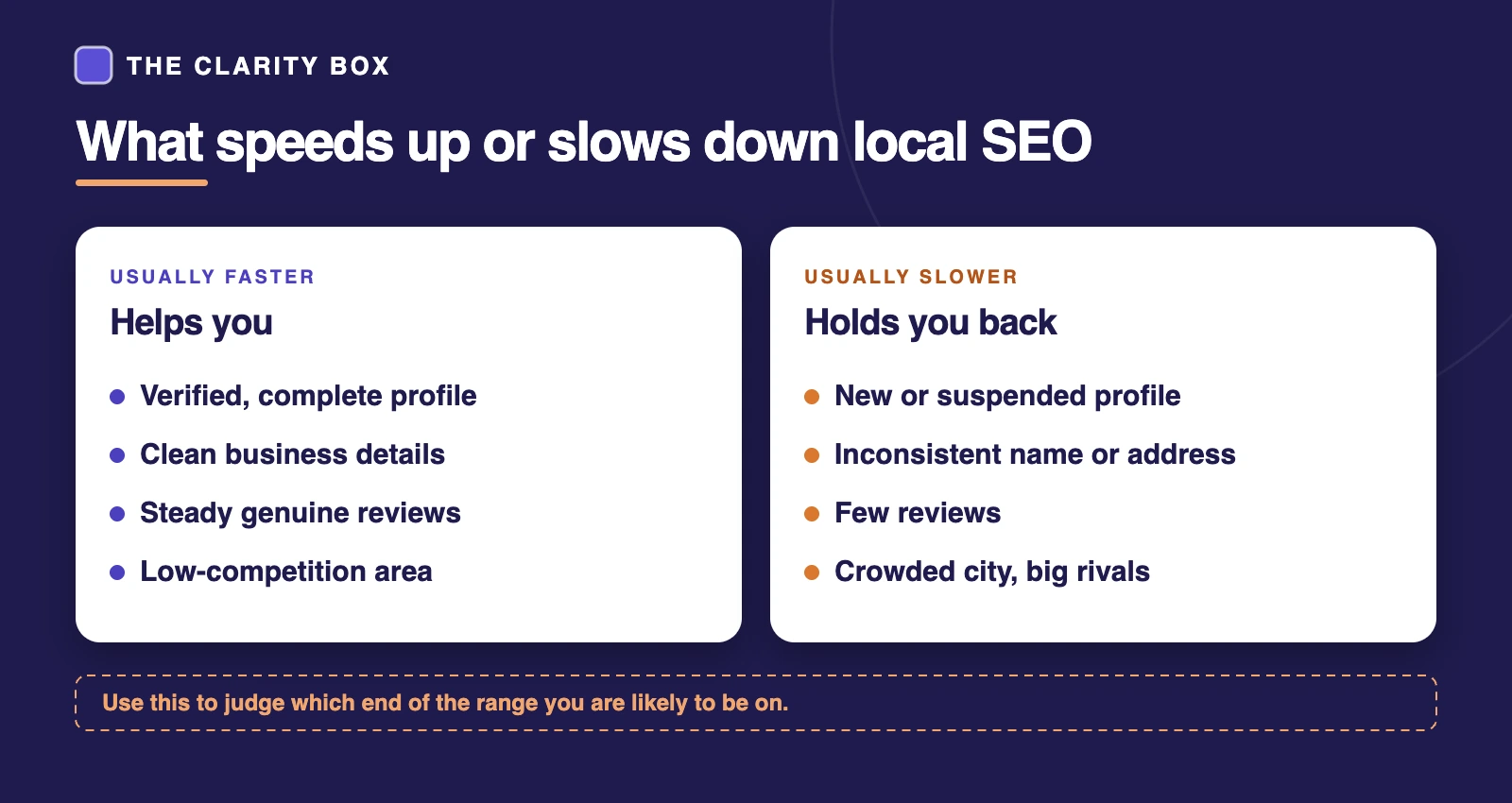
Seven things matter most: how healthy your profile is (a new, duplicate or suspended profile slows everything; see our suspension playbook), how many genuine reviews you have and how recent they are, how consistent your business details are, how good your pages are, how crowded your area is, how consistently the work is done, and how many locations you are covering at once.
A quick self-check (our rule of thumb, not a Google metric). Count how many of these are true for you: your profile has been verified for six months or more; you have 25 or more genuine reviews, with some from the last few months; your name, address and phone are identical everywhere; you have a dedicated page for each main service and area; and no direct competitor in your area has far more reviews than you. With four or five true, expect the quicker end of the range. With two or three, expect the middle. With none or one, plan for six months or more and start with the foundations.
Simple profile edits such as hours, photos, services and posts can appear within a few days, although some changes go through Google’s review and take longer. A newly created or newly verified profile often needs a few weeks to settle before it appears reliably. Ranking improvements that come from reviews, categories and proximity signals take longer, typically a few months. Website changes are slower again: Google’s own documentation says a recrawl can take from a few days to a few weeks, and ranking changes come after that.
| Stage | Watch these | Do not over-read |
|---|---|---|
| Months 1–3 | Profile impressions, new search terms in Search Console, tracking working | Lead numbers, which are still small |
| Months 4–6 | Calls, direction requests, form enquiries, review growth, map position by area | A single day’s ranking from your own device |
| Months 7–12 | Enquiries by page and service, share of nearby searches, cost of effort versus leads | Short dips after Google updates |
If you have done consistent work for around six months and impressions, calls and enquiries have not moved at all, look for a cause before waiting longer. The common ones are a suspended or filtered profile, duplicate listings, a wrong primary category, thin or duplicated service pages, very few reviews, broken tracking, and targeting terms that nobody searches. Our guide to why Google Business Profile rankings drop covers the profile side in detail. Avoid shortcuts such as bought reviews or low-quality links: they risk a suspension, which sets you back further than patience would.
A new business usually needs longer, because the Google Business Profile has to be created and verified and there are no reviews or history yet. Plan for the foundation work to take the first few weeks and for clear traction to take closer to the six-month mark. It is a typical pattern, not a guarantee.
Often, for map results in a small area, because the competitors are only the businesses near you and profile changes can show quickly. Ranking organic pages for competitive service keywords takes about as long as any other SEO.
Three months is often still the foundation stage. If your impressions and calls have not moved at all, check for a profile that is suspended or filtered, duplicate listings, a wrong primary category, thin service pages and broken tracking before assuming it needs more time.
Rankings are not permanent. Competitors keep collecting reviews and publishing pages, so the second year is mostly maintenance and refinement: steady reviews, fresh photos, updated pages and tracking what brings enquiries.
THE CLARITY BOX checks your profile, your site and your local competition in a free SEO audit and tells you which end of the range is realistic for you. You can also see how our local SEO service works, or start from the homepage.
If you have a quote or a report from one of these firms or any other, we’ll read it with you and show you where your business appears for your main searches.
Saba is an SEO and growth strategist with over 10 years of experience in SEO, content strategy, and digital marketing. She writes about organic growth, content optimization, technical SEO, and AI-powered search, translating complex concepts into practical, data-informed insights that help businesses make smarter marketing decisions.