How a clinic owner can choose a healthcare SEO agency that respects college advertising rules and patient privacy, with a sign-off map and eight questions to ask.

SEO & Growth Strategist · 10+ years experience
Share this article
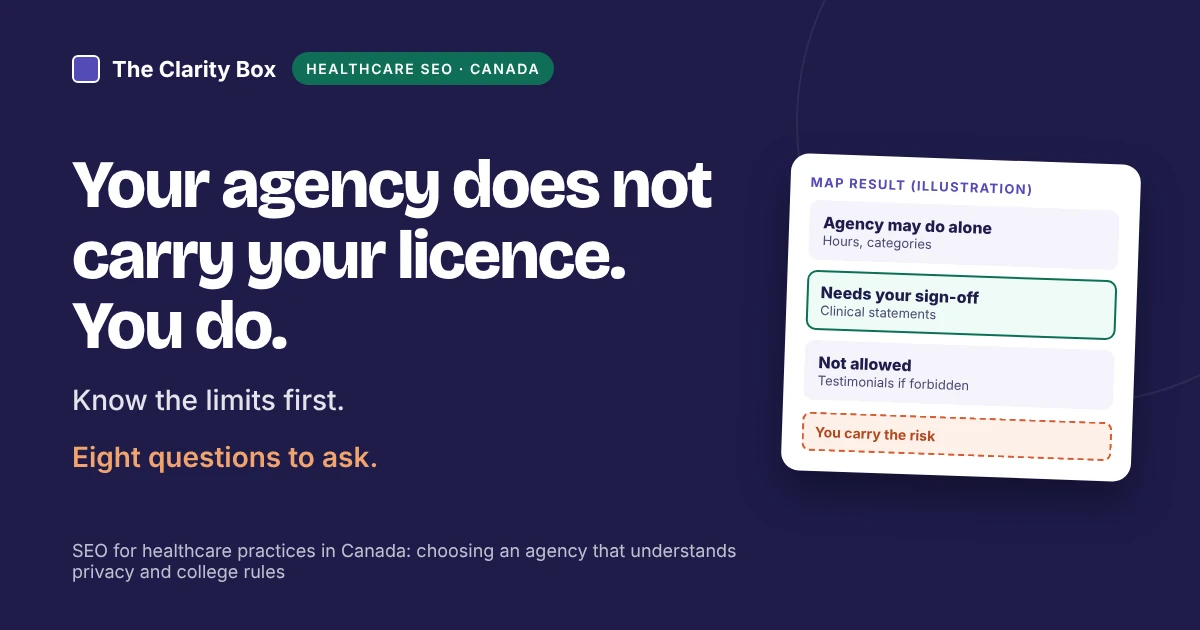
Your college’s advertising rules and your province’s health-privacy law apply to everything an agency does for your clinic, and you carry the risk. This guide shows what to sort out before you sign. As of November 13, 2026.
Key takeaways
A clinic is not a retail shop. Its advertising is regulated by a college, its patient information is protected by privacy law, and a single careless post can lead to a complaint. Many agency pages for healthcare promise growth but say nothing about these limits. The result is a clinic that follows the agency’s advice and discovers the problem later.
This guide is for the owner or administrator of a private clinic, a multi-practitioner practice, or an allied-health group. If you are a single practitioner looking for tactics, see our page on SEO for healthcare practices.
This is a starting point, not legal advice. Your college’s current text decides.
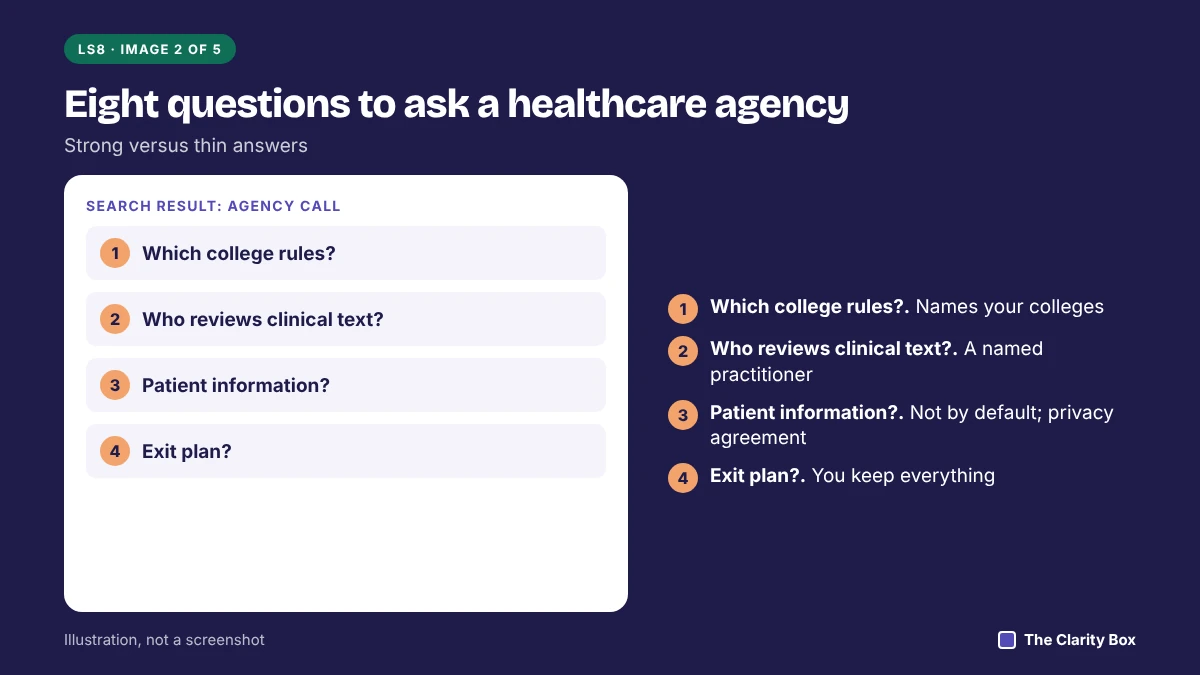
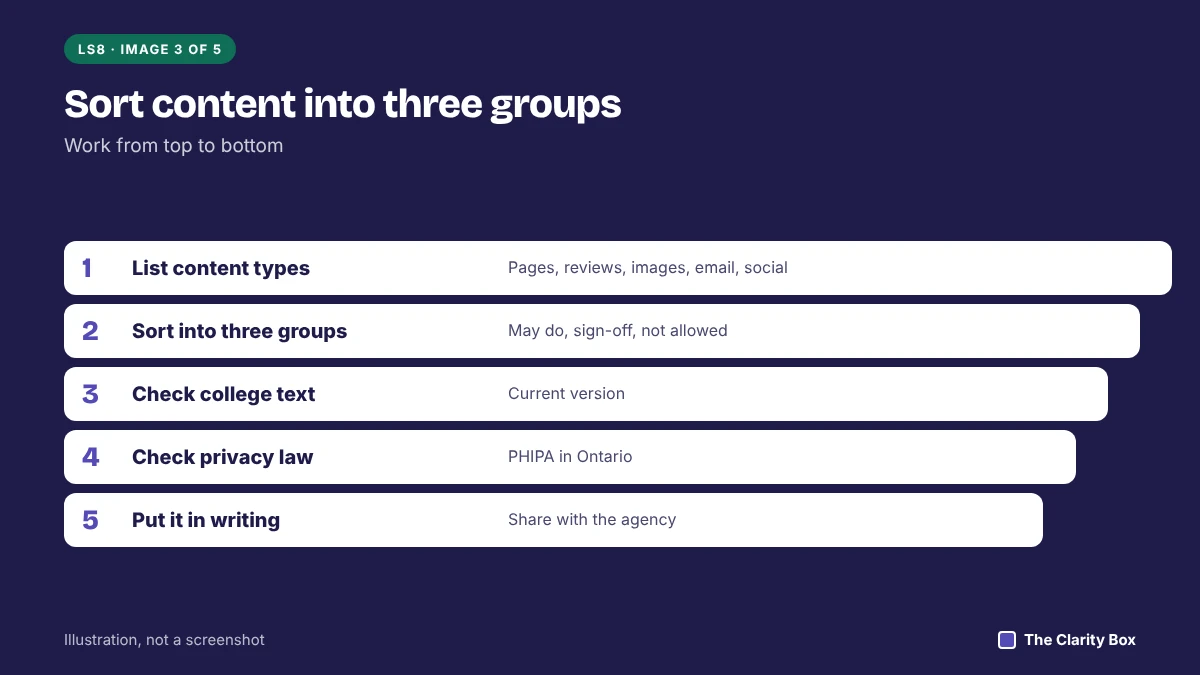
| Content type | Agency may do alone | Needs your written sign-off | Not allowed (check your college) |
|---|---|---|---|
| Google Business Profile details | Fix hours, categories, services using facts you provide | Profile description, special announcements | Keywords added to the business name |
| Service pages | Draft from your material | Every clinical statement, with a named practitioner reviewing it | Outcome promises, comparisons with other practitioners |
| Patient reviews | Ask real patients to write a review | Replies to any review that mentions care | Writing, buying, or filtering reviews; publishing testimonials where your college forbids them |
| Before-and-after images | Nothing | Any image, with written patient consent and college compliance | Images without consent or beyond what your college allows |
| Email and newsletters | Format and send to a consented list | Content and list building | Messages without consent under Canada’s Anti-Spam Legislation |
| Analytics and call tracking | Set up with your approval | Anything that records calls or patient data | Sharing patient details with the agency without a privacy agreement |
| Social media | Schedule approved posts | Every post | Posts that identify a patient |
A “not for” note: this table does not cover advertising for pharmaceuticals or devices, which have separate federal rules, and it does not replace advice from your college.
| # | Question | Strong answer | Thin answer |
|---|---|---|---|
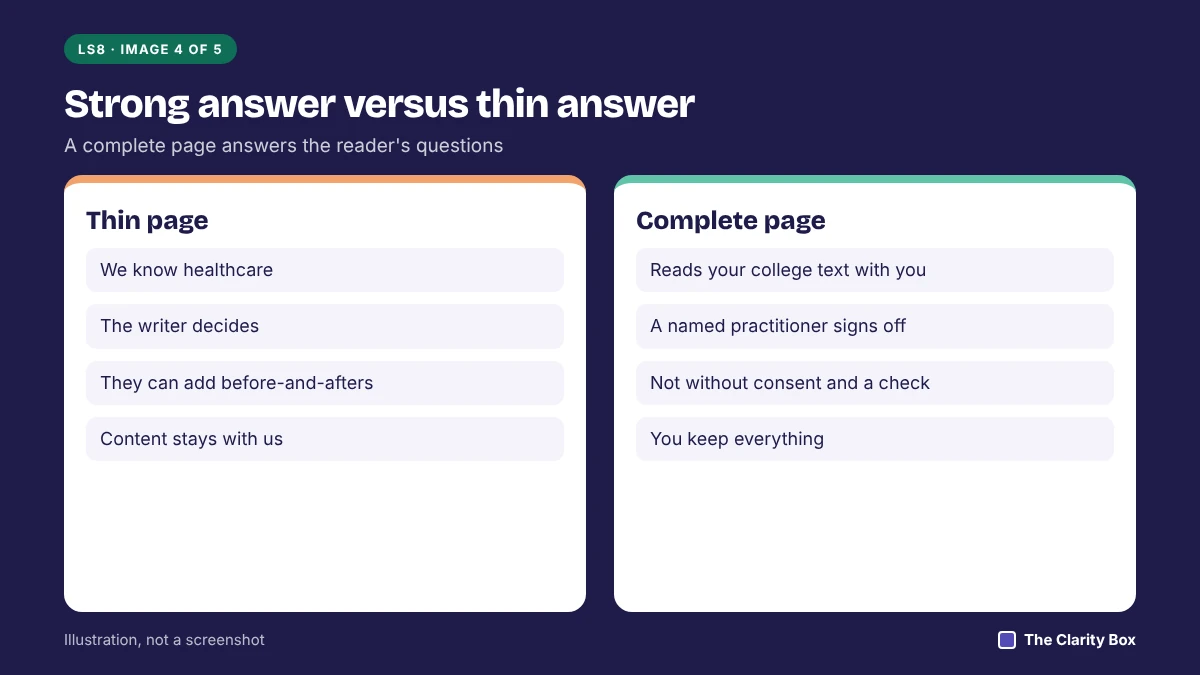
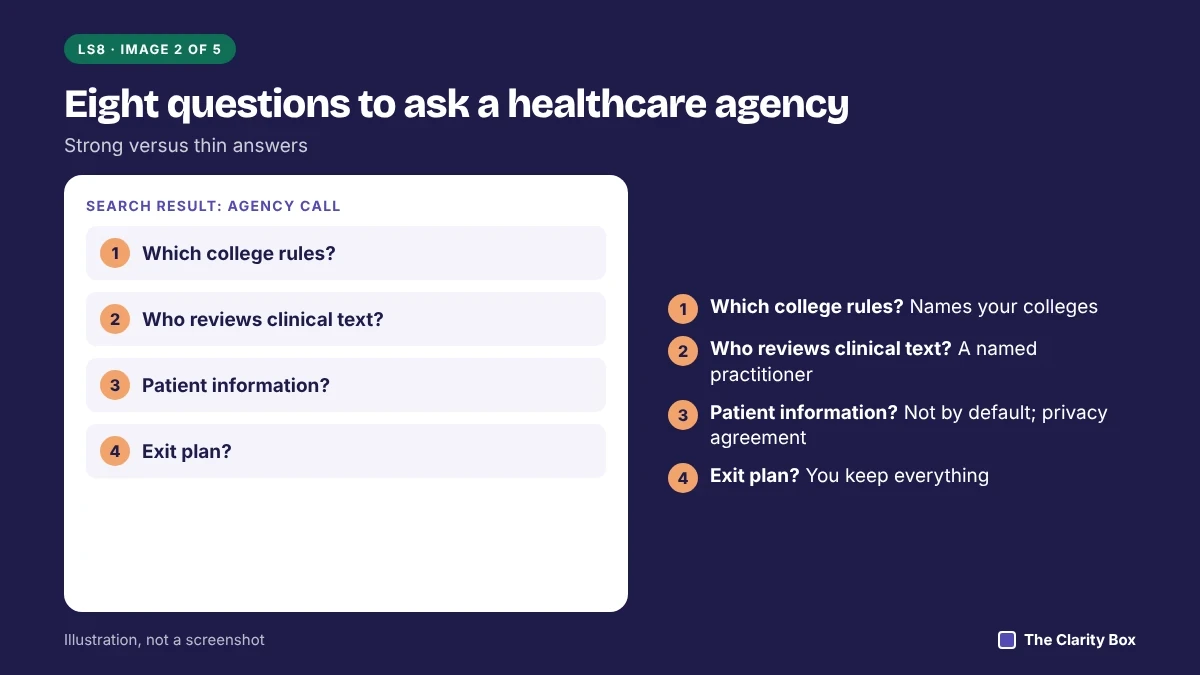
| 1 | Which college rules apply to my practitioners, and where do you read them? | Asks which colleges you belong to and reads the current text with you | “We know healthcare” |
| 2 | Who reviews clinical statements before they go live? | A named practitioner on your team signs off each page | The agency’s writer decides |
| 3 | How do you handle testimonials and reviews? | Asks patients to review on Google; no curation, no incentives, no testimonial pages if your college forbids them | Promises review pages with five-star quotes |
| 4 | Will you ever see patient information? | Not by default; if so, under a written privacy agreement | Has access to booking systems without a plan |
| 5 | How do you handle before-and-after images? | Not without consent and a check against the college text | “We can add those” |
| 6 | Who owns the accounts and content? | You do; the agency is a manager | The agency does |
| 7 | What can you not promise? | No guaranteed rankings or patient numbers | A promised date for first page |
| 8 | What is the exit plan? | You keep everything; handover described | Content stays with the agency |
On the first page of google.ca (Canada-targeted results, not city-level, checked November 2026) the results are mostly agency pages for healthcare marketing. Few name a Canadian college, few address privacy law, and few give a questions list with strong and thin answers. This page adds the compliance map and the questions. For the local search basics, see local SEO and our guide to local SEO for dentists.
Not if your college forbids them. CPSO’s policy, for example, does not allow them for physicians.
Only with a privacy agreement and a clear reason.
Possibly, but your college’s rule and written consent come first.
Only if Google’s practitioner guidance fits.
Size matters less than the answers to the eight questions.
Yes. Put each of the eight questions to the agency in writing and compare the answers. Our SEO proposal questions can help too.
If you want to walk through these questions with an agency that will answer them, book your call with THE CLARITY BOX.
Saba is an SEO and growth strategist with over 10 years of experience in SEO, content strategy, and digital marketing. She writes about organic growth, content optimization, technical SEO, and AI-powered search, translating complex concepts into practical, data-informed insights that help businesses make smarter marketing decisions.