Map calls dropped but the website didn't change? 11 causes outside your site, from suggested edits to spam listings, with...
Read More
Three SEO proposals can look almost identical. These 11 questions show what each provider found, who does the work, and what you own when it ends, with a strong and a thin answer for each.

SEO & Growth Strategist · 10+ years experience
Share this article
Three SEO proposals can look almost identical: the same audit, the same “content strategy”, the same monthly report, and a 12-month term. The differences that matter sit in what each provider found before writing, who does the work, and what you own when it ends. Google’s own guide to hiring an SEO, updated in June 2026, says no one can guarantee a top ranking. These 11 questions show the rest.
A note on where we stand: The Clarity Box sells SEO services, so we have a stake in how you judge proposals, including ours. Every question below applies to us too, and we would rather you used them on us than skipped them.
Key takeaways
Because the usual ways of comparing them measure the provider’s marketing, not the work you would get. Three common shortcuts tend to mislead:
The questions that separate proposals are about specifics: what the provider found, what they will do first, how they will prove it worked, and what you keep when you leave. Google’s guide to hiring an SEO makes the same point from the other side: be wary of anyone who can’t clearly explain what they intend to do and why.
Key point: a strong proposal could only have been written for your business. If you could swap in a competitor’s name and nothing else changes, keep asking questions.
Ask them in a call, not by email, and listen for specifics: names, dates, numbers, and things only someone who looked at your business would know.
This is the question that separates diagnosis from a template. If you want to know what a provider should be able to spot, our 30-minute search health check walks through the same first look.
The first month shows whether there is a plan or a retainer.
Rankings and traffic are signals. Calls, form fills, bookings, and qualified leads are results.
The person who pitched may not be the person who works on your account.
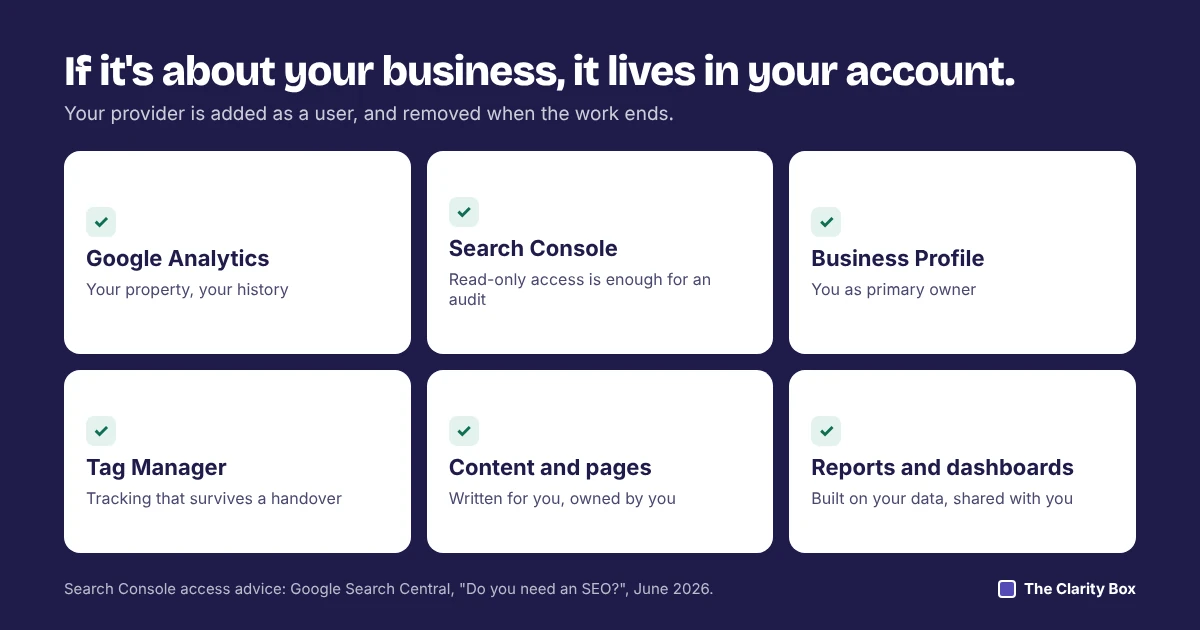
Your Google Analytics property, Search Console, Business Profile, Tag Manager, content, and any tools set up for you should sit in your accounts. Google’s guide advises giving an SEO read-only Search Console access for an audit, rather than write access.
Links still matter, and how they are earned matters more. Google’s guide lists link schemes as a warning sign.
Knowing what sits outside the scope prevents most disputes later.
This is where guarantees appear. Google says no one can guarantee a top ranking.
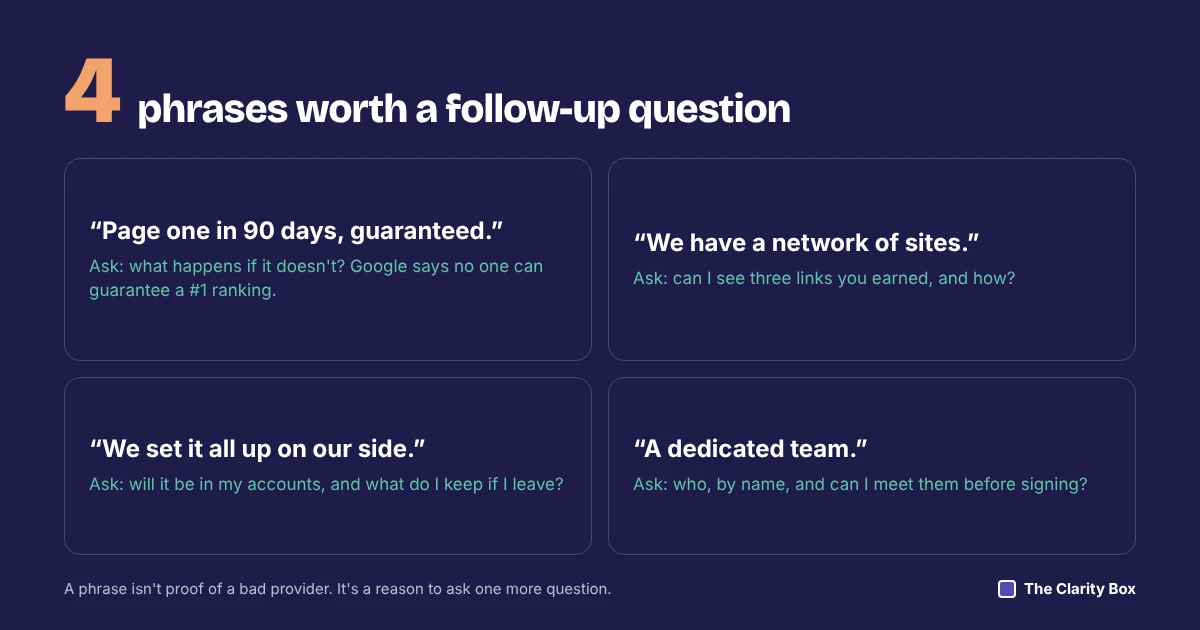
The exit terms tell you how the provider expects to keep you: by results, or by contract.
AI answers now sit at the top of many results pages. In our study of 7,090 Canadian searches, 72.9% showed an AI Overview, so it is fair to ask. It is also an area where many proposals add a new line item.
A reference from a similar business is worth more than a case study.
Key point: the most revealing question is often the first one. A provider who found something specific before writing the proposal has already started doing the job.
Print this or keep it open on the call. Each row is the short version of a question above.

| # | Question | A strong answer includes | A thin answer sounds like |
|---|---|---|---|
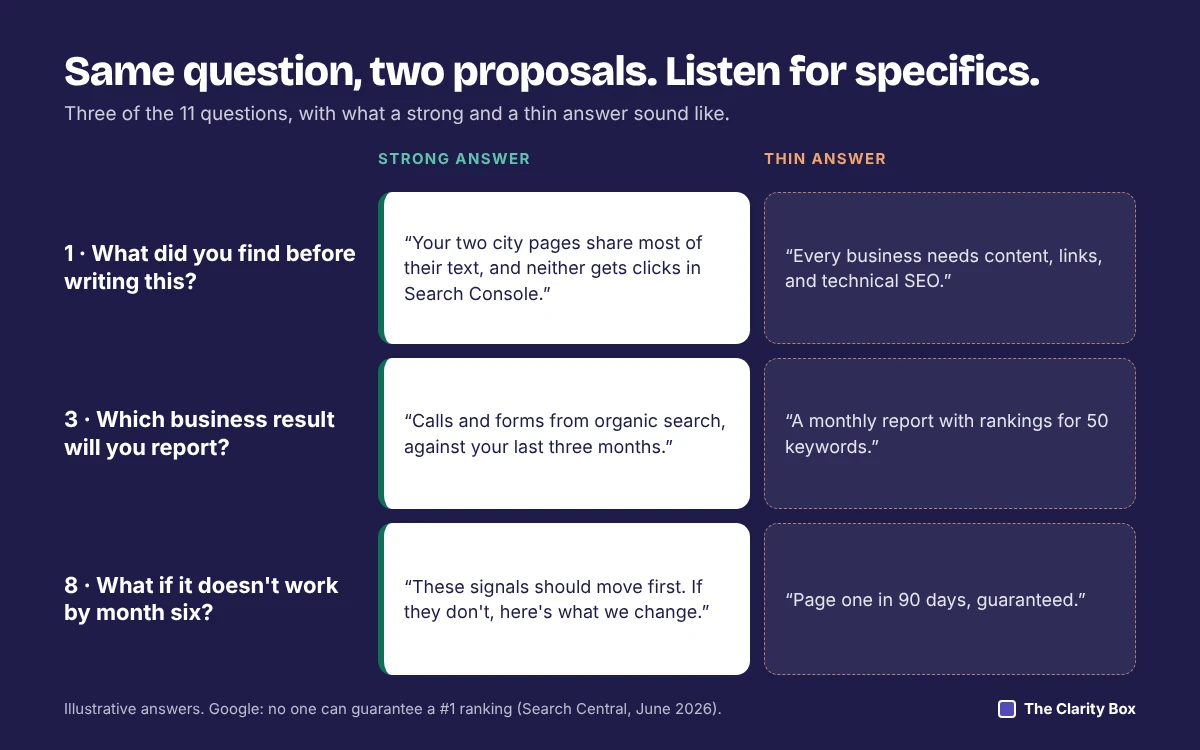
| 1 | What did you find before writing this? | Specific problems on your site or profile | “Every business needs content and links” |
| 2 | What happens in the first 30 days? | Named tasks, in order, with owners | “Onboarding and research” |
| 3 | Which business result will you report on? | Calls, forms, or bookings against a baseline | Rankings for a long keyword list |
| 4 | Who will do the work? | Named people and how often you’ll hear from them | “A dedicated team” |
| 5 | Who owns the accounts and assets? | Everything in your accounts, you add them as users | “We set it up on our side” |
| 6 | How do you earn links? | Real examples, and what they won’t do | A network of sites, links per month at a fixed price |
| 7 | What is not included? | A plain list of exclusions | “We take care of everything” |
| 8 | What by month three and six? | Ranges from your starting point, and a plan B | A ranking guarantee |
| 9 | How do I leave? | Reasonable notice, full handover, no fee for your accounts | Auto-renewing 12-month term, no handover |
| 10 | How do you handle AI search? | What they check, how often, how it’s measured | A new acronym and a separate fee |
| 11 | Can I call a current client? | Two similar clients, called without them | “Our clients are confidential” |
It is built for a business choosing an ongoing SEO provider. It fits less well in three cases:
One more piece of advice, from a firm that sells SEO: if another provider answers all 11 well and suits your budget better, hire them.
The questions don’t. What changes is the paperwork around them.
If you want a second opinion on a proposal you already have, an independent SEO audit shows what is actually wrong with the site, and our SEO strategy page explains how The Clarity Method turns findings into a plan. You can also start with a free audit.
Start with what they found before writing the proposal, what happens in the first 30 days, which business result they will report on, who does the work, who owns the accounts, and how you leave. The full list of 11 is in this article, each with a strong and a thin answer.
Ask for the starting number, the timeframe, and a client you can call. A percentage without a baseline can't be checked, and a provider with real results can usually give all three.
No. Google's own guide to hiring an SEO states that no one can guarantee a #1 ranking on Google. Treat a guarantee as a reason to look elsewhere.
You should. Set them up under your business's own Google account and add the provider as a user. For an audit, Google suggests giving read-only access to Search Console.
Not always. Some clients ask for confidentiality. A good provider will still offer something you can check, such as a call with a current client or a redacted example of their work.
It depends on where you start, how competitive your market is, and how quickly changes get made. Google's guide suggests asking the provider directly what results to expect and in what timeframe. A strong answer gives ranges and early signals, not a single date.
Share this article
Saba is an SEO and growth strategist with over 10 years of experience in SEO, content strategy, and digital marketing. She writes about organic growth, content optimization, technical SEO, and AI-powered search, translating complex concepts into practical, data-informed insights that help businesses make smarter marketing decisions.
Map calls dropped but the website didn't change? 11 causes outside your site, from suggested edits to spam listings, with...
Read MoreWhy Google suspends Business Profiles, what to fix first, and how to use your one appeal: the steps, the evidence...
Read MoreEvery AI search article quotes a different number. Here are 20, each traced to its study, with the sample, date,...
Read More