Map calls dropped but the website didn't change? 11 causes outside your site, from suggested edits to spam listings, with...
Read More
Every AI search article quotes a different number. Here are 20, each traced to its study, with the sample, date, country, and what the number cannot tell you.

SEO & Growth Strategist · 10+ years experience
Share this article
Every AI search article quotes a different number, and few say where it came from. One says AI answers cut clicks by a third, another says by more than half. Both can be right, because they measure different things. This page gives 20 numbers, each traced to the study that produced it, with the sample, date, country, and what the number cannot tell you.
Last verified: 25 October 2026 · Next review: 25 January 2027
Key takeaways
Hundreds of millions, on several platforms, and a growing share use it to find local businesses. The usage figures come from the companies themselves, so treat them as reach, not as evidence of how people choose a business.
1. More than 1 billion monthly active users of Google’s AI Mode. Stated by Sundar Pichai in Alphabet’s Q2 2026 earnings remarks, 22 July 2026 (Google). Global. What it doesn’t tell you: how often each user uses it, or for what kind of search.
2. 950 million monthly active users of the Gemini app. Same source and date. Global. What it doesn’t tell you: how much of that use is search rather than writing or other tasks.
3. 900 million weekly active ChatGPT users. Announced by OpenAI on 27 February 2026, up from 800 million in October 2025, as reported by TechCrunch. Global. What it doesn’t tell you: the share used for finding businesses or products.
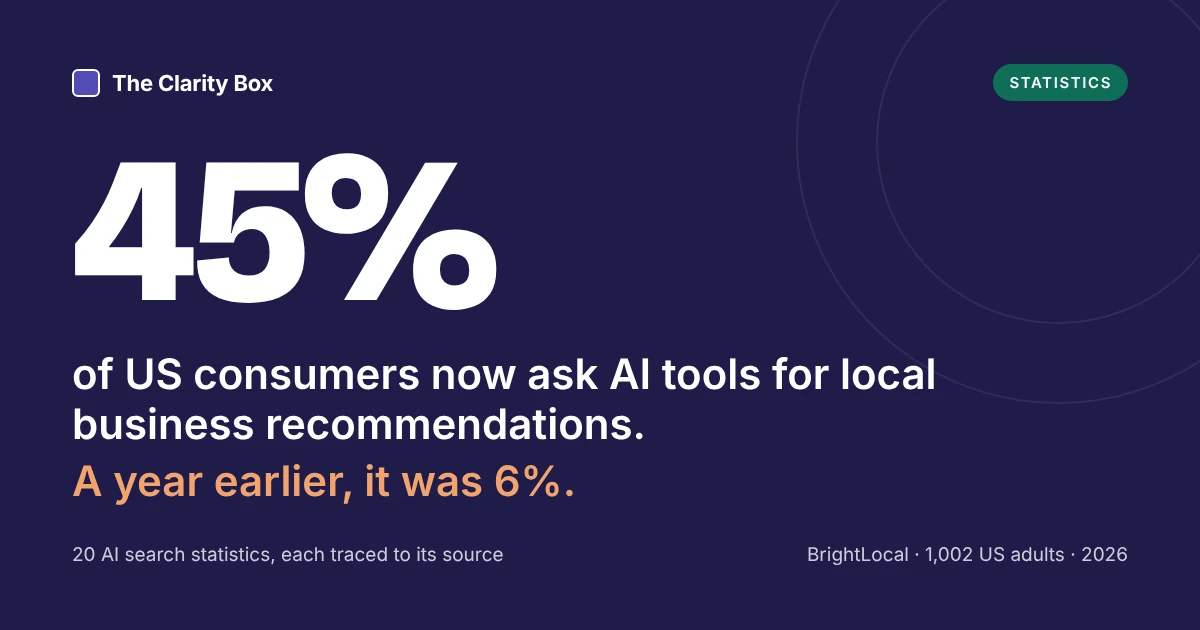
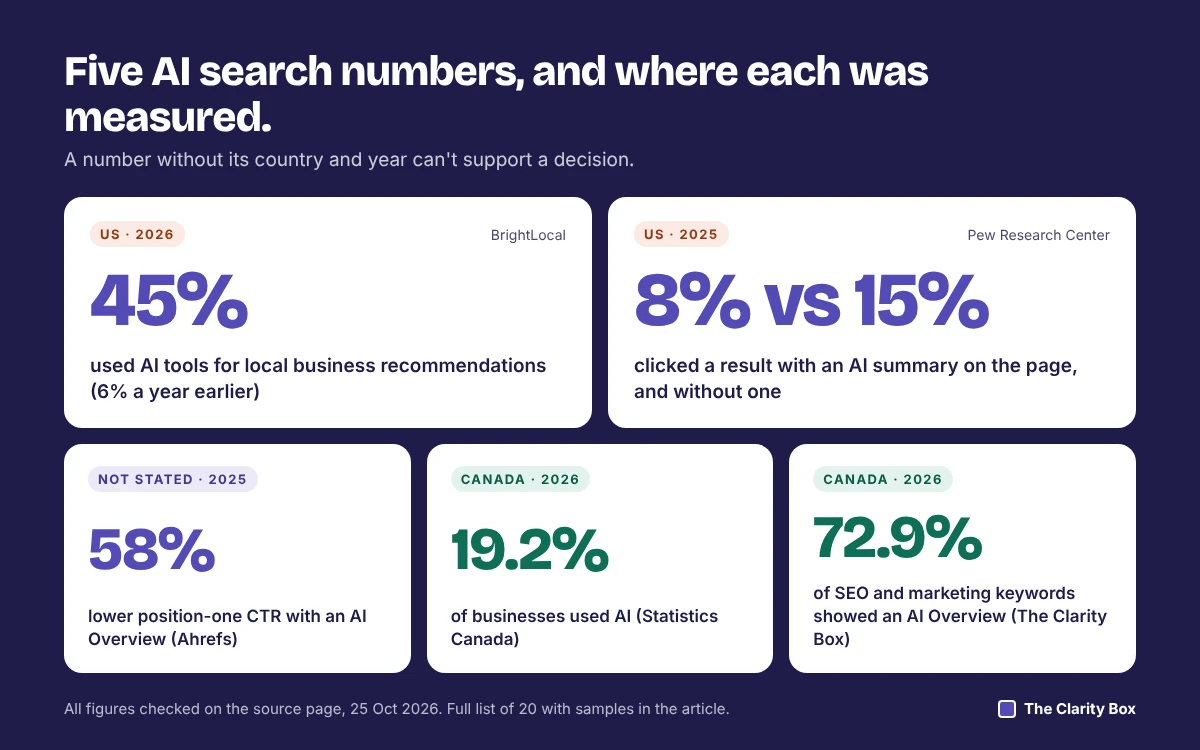
4. 45% of US consumers used ChatGPT or other AI tools for local business recommendations, up from 6% a year earlier. BrightLocal Local Consumer Review Survey 2026, 1,002 US adults, published 11 February 2026 (BrightLocal). What it doesn’t tell you: how often, and whether the AI recommendation decided the choice. The size of the jump from one year to the next is worth watching in the 2027 edition before treating it as a settled trend.
5. 40% of US consumers trust AI platforms to provide business recommendations. Same BrightLocal survey. What it doesn’t tell you: trust compared with what. BrightLocal separately reports 42% trust AI as much as traditional reviews.
6. 82% of US consumers read AI-generated review summaries. Same BrightLocal survey, which adds that 23% would rely on the summary alone. What it doesn’t tell you: which platforms’ summaries, and whether reading changed the decision.
Key finding: the jump that matters for a local business is not total AI usage. It is the 45% of US consumers who now ask AI tools which local business to use.
Yes, in every study that has measured it, but by different amounts because each study measures something different. One tracks what people did, one compares click-through rates on the same keywords over time, and one counts searches that ended with no click at all.
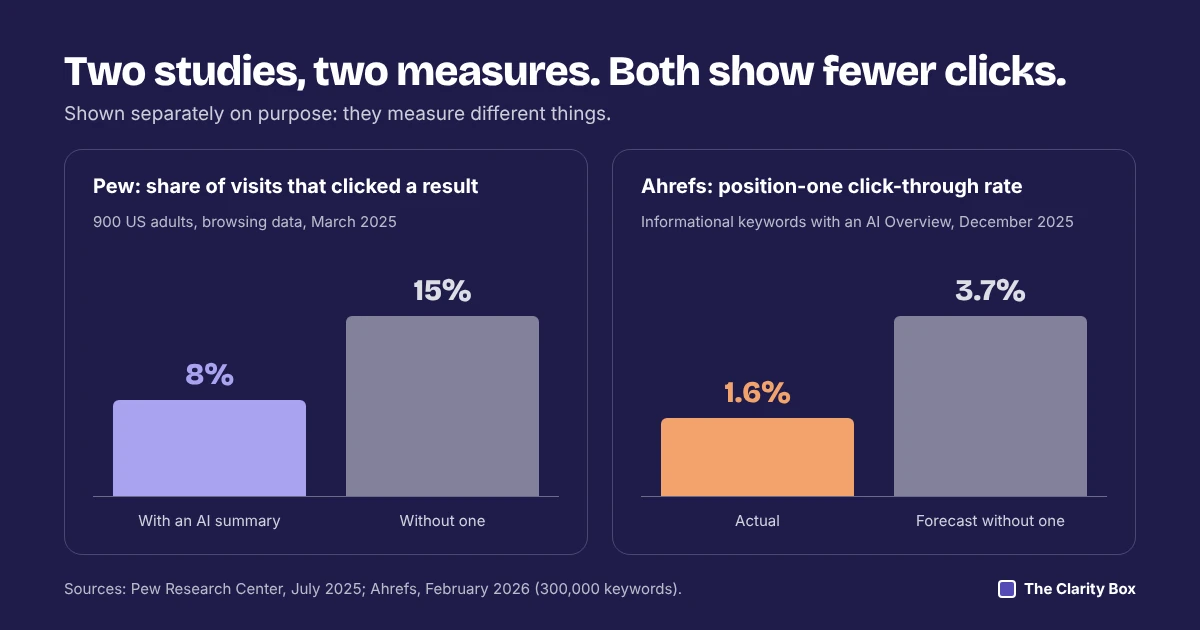
7. 8% of visits to a results page with an AI summary led to a click on a result, against 15% without one. Pew Research Center, browsing data from 900 US adults in March 2025, published 22 July 2025 (Pew). What it doesn’t tell you: whether the searches with summaries were a different kind of search to begin with.
8. 1% of visits to a page with an AI summary led to a click on a link inside the summary. Same Pew study. What it doesn’t tell you: how this varies by topic. For local and commercial searches, the summary is often not the main result.
9. 26% of visits ended the browsing session after a page with an AI summary, against 16% without one. Same Pew study. What it doesn’t tell you: whether people left satisfied or gave up.
10. Position-one click-through rate was about 58% lower where an AI Overview showed: 1.6% in December 2025, against a forecast of 3.7% without one. Ahrefs, 300,000 informational keywords, aggregated Google Search Console data, published 4 February 2026 (Ahrefs). Country not stated. What it doesn’t tell you: anything about commercial or local keywords, which were not in the sample.
11. 34.5% lower click-through to top-ranking pages, in Ahrefs’ earlier study. Reported by Ahrefs for April 2025 and cited in the same February 2026 update. What it doesn’t tell you: why the newer figure is larger. The two studies used different time windows and samples, so read them as two measurements, not a contradiction.
12. 58.5% of US Google searches ended with no click, and 59.7% in the EU. SparkToro and Datos, clickstream panel data, published 1 July 2024 (SparkToro). What it doesn’t tell you: the effect of AI Overviews specifically, which were not widespread for most of the period studied.
13. 360 of every 1,000 US Google searches sent a click to a website Google doesn’t own; 374 in the EU. Same SparkToro and Datos study. What it doesn’t tell you: where those clicks went, or whether any were to local businesses.
Key finding: the studies agree on the direction and differ on the size. For a click from an informational search, Ahrefs’ 58% is the most recent large measure; for what people actually do, Pew’s 8% against 15% is the clearest.
It depends heavily on the kind of search. Long questions trigger AI answers far more than short searches, and searches for a local provider trigger them least.
14. 18% of Google searches produced an AI summary. Pew Research Center, 68,879 searches by 900 US adults in March 2025 (Pew). What it doesn’t tell you: today’s rate. Google has expanded AI features since March 2025, so treat this as a dated snapshot.
15. 60% of searches that used a question word produced an AI summary, and 53% of searches of 10 words or more. Same Pew study; only 8% of one- or two-word searches did. What it doesn’t tell you: how this applies to your keywords. Check your own.
16. 72.9% of 7,090 Canadian keywords about SEO and marketing help showed an AI Overview. The Clarity Box, Semrush data for Canada, snapshots from August to October 2026 (our study). What it doesn’t tell you: anything about all Canadian searches. The sample is keywords five SEO agencies rank for.
17. 94.8% of informational keywords showed an AI Overview, against 31.5% of transactional ones. Same Clarity Box study. What it doesn’t tell you: clicks. It measures what appeared, not what people did next.
18. 25.7% of “near me” keywords showed an AI Overview, while 87.8% showed the local map pack. Same Clarity Box study, 148 keywords. What it doesn’t tell you: a precise rate. The group is small, so read it as a strong pattern.
Key finding: AI answers cluster on research questions. For the searches closest to a booking, the map is still the first thing most people see.
Canada has good data on how businesses use AI and very little on how consumers use AI to search. Most figures quoted to Canadian business owners are US numbers, often without saying so.
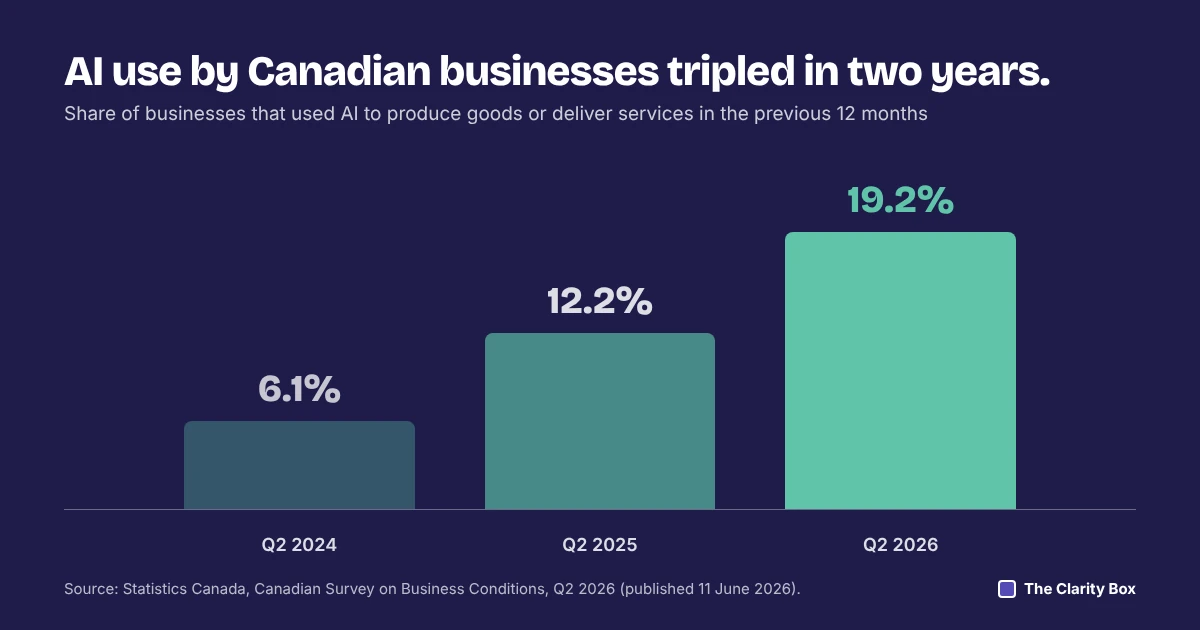
19. 19.2% of Canadian businesses used AI to produce goods or deliver services in the previous 12 months, up from 12.2% a year earlier and 6.1% two years earlier. Statistics Canada, Canadian Survey on Business Conditions, collected 1 April to 6 May 2026, published 11 June 2026 (Statistics Canada). What it doesn’t tell you: anything about AI in search or marketing. It measures business use of AI in production and service delivery.
20. 19.9% of Canadian businesses with 1 to 4 employees used AI in the same period. Same Statistics Canada release. What it doesn’t tell you: what the AI was used for. It does show that the smallest firms are adopting at about the national rate.
What Canada does not have yet: we could not find a public, recent survey of how Canadian consumers use AI tools to find local businesses, or a Canadian click study comparable to Pew’s or Ahrefs’. Until one exists, any “Canadian” AI search figure is very likely a US figure. Our study of 7,090 Canadian searches covers what appears on the page, not what people do.
Key finding: the share of Canadian businesses using AI tripled in two years, from 6.1% to 19.2%. We could not find comparable data on Canadian customers using AI to find them.
Copy a row with its source. Every figure was checked on the source page on 25 October 2026.
| # | Statistic | Source | Sample | Date | Country |
|---|---|---|---|---|---|
| 1 | 1 billion+ monthly AI Mode users | Google (Alphabet Q2 2026 remarks) | Company figure | July 2026 | Global |
| 2 | 950 million monthly Gemini app users | Google (Alphabet Q2 2026 remarks) | Company figure | July 2026 | Global |
| 3 | 900 million weekly ChatGPT users | OpenAI, via TechCrunch | Company figure | February 2026 | Global |
| 4 | 45% used AI tools for local recommendations (6% a year earlier) | BrightLocal Local Consumer Review Survey | 1,002 adults | February 2026 | US |
| 5 | 40% trust AI platforms for business recommendations | BrightLocal | 1,002 adults | February 2026 | US |
| 6 | 82% read AI-generated review summaries | BrightLocal | 1,002 adults | February 2026 | US |
| 7 | 8% clicked a result with an AI summary, 15% without | Pew Research Center | 900 adults, browsing data | March 2025 | US |
| 8 | 1% clicked a link inside the AI summary | Pew Research Center | 900 adults | March 2025 | US |
| 9 | 26% ended the session after an AI summary, 16% without | Pew Research Center | 900 adults | March 2025 | US |
| 10 | Position-one CTR about 58% lower with an AI Overview | Ahrefs | 300,000 informational keywords | Dec 2023 vs Dec 2025 | Not stated |
| 11 | 34.5% lower CTR to top pages (earlier study) | Ahrefs | Not restated | April 2025 | Not stated |
| 12 | 58.5% of searches ended with no click (EU 59.7%) | SparkToro and Datos | Clickstream panel | 2024 | US, EU |
| 13 | 360 open-web clicks per 1,000 searches (EU 374) | SparkToro and Datos | Clickstream panel | 2024 | US, EU |
| 14 | 18% of searches produced an AI summary | Pew Research Center | 68,879 searches | March 2025 | US |
| 15 | 60% of question-word searches produced an AI summary | Pew Research Center | 68,879 searches | March 2025 | US |
| 16 | 72.9% of SEO and marketing keywords showed an AI Overview | The Clarity Box | 7,090 keywords (Semrush) | Aug to Oct 2026 | Canada |
| 17 | 94.8% of informational vs 31.5% of transactional keywords | The Clarity Box | 7,090 keywords (Semrush) | Aug to Oct 2026 | Canada |
| 18 | 25.7% of “near me” keywords showed an AI Overview | The Clarity Box | 148 keywords (Semrush) | Aug to Oct 2026 | Canada |
| 19 | 19.2% of businesses used AI (12.2% and 6.1% in prior years) | Statistics Canada | Canadian Survey on Business Conditions | Q2 2026 | Canada |
| 20 | 19.9% of businesses with 1 to 4 employees used AI | Statistics Canada | Same survey | Q2 2026 | Canada |
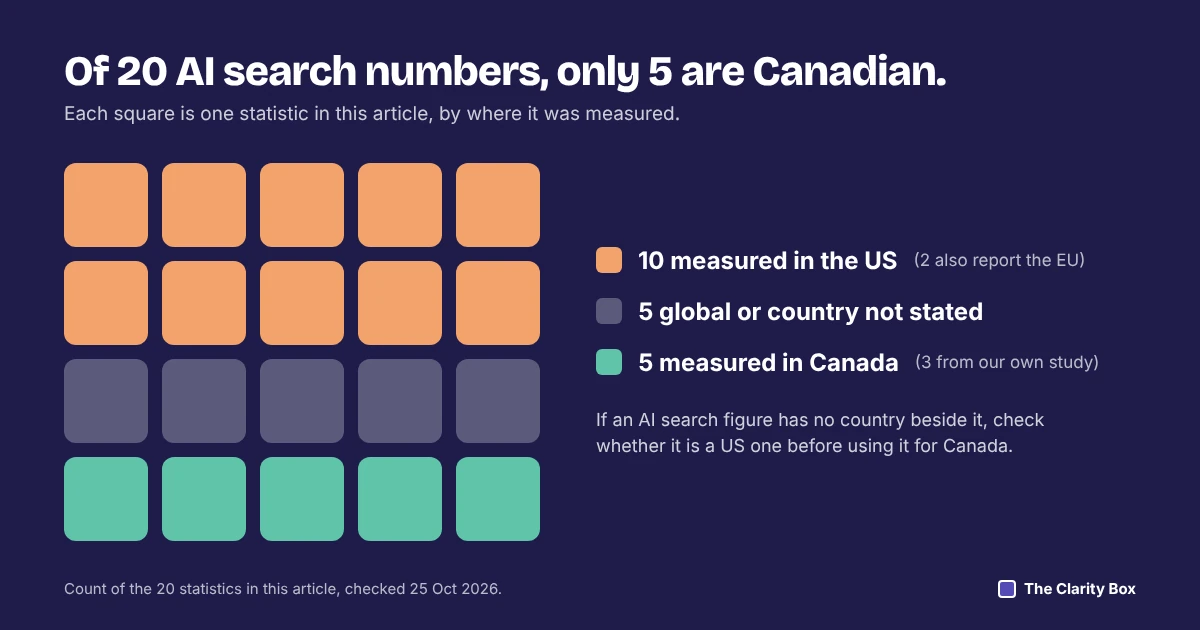
Fifteen of the 20 figures describe the US, the EU, the whole world, or a country the source does not state. Five are Canadian, and three of those come from our own study.
Match the number to the question you are asking. Four checks catch most misuse:
Numbers worth leaving out until you can check them
Key finding: the most useful AI search number for your business is one you measure yourself, in your own Search Console data, for your own searches.
Numbers like these only matter once you know how they apply to your business. Our AI search and entity SEO work focuses on being understood and cited by AI answers, and content SEO covers the pages those answers draw from. Start with a free audit from The Clarity Box.
It depends on the search. Pew found an AI summary on 18% of Google searches by 900 US adults in March 2025. In our 2026 sample of 7,090 Canadian SEO and marketing keywords, 72.9% showed one, and long, question-style searches show them most.
Yes. Pew found people clicked a result on 8% of visits with an AI summary against 15% without (US, March 2025). Ahrefs found position-one click-through about 58% lower where an AI Overview showed, across 300,000 informational keywords (December 2025).
In BrightLocal's 2026 survey of 1,002 US adults, 45% said they had used ChatGPT or other AI tools for local recommendations, up from 6% the year before. We could not find a comparable Canadian figure.
19.2% of Canadian businesses used AI to produce goods or deliver services in the 12 months before the Q2 2026 survey, according to Statistics Canada. That is up from 6.1% two years earlier.
Most of the widely quoted ones, including the Pew click study, the BrightLocal consumer survey, and the SparkToro zero-click study. In this list, 15 of 20 figures are not Canadian.
Every three months. We review this page quarterly and show the date of the last check at the top.
Share this article
Saba is an SEO and growth strategist with over 10 years of experience in SEO, content strategy, and digital marketing. She writes about organic growth, content optimization, technical SEO, and AI-powered search, translating complex concepts into practical, data-informed insights that help businesses make smarter marketing decisions.
Map calls dropped but the website didn't change? 11 causes outside your site, from suggested edits to spam listings, with...
Read MoreWhy Google suspends Business Profiles, what to fix first, and how to use your one appeal: the steps, the evidence...
Read MoreThree SEO proposals can look almost identical. These 11 questions show what each provider found, who does the work, and...
Read More