Map calls dropped but the website didn't change? 11 causes outside your site, from suggested edits to spam listings, with...
Read More
Google removes reviews that break its content rules, not reviews that are unfair. Here is how to report one, use your single appeal, and reply well when a review stays up.

SEO & Growth Strategist · 10+ years experience
Share this article

A one-star review appears overnight. It describes a visit you have no record of, or it attacks a staff member by name. The instinct is to get it deleted today. Google will remove a review only when it breaks one of its published content rules, and “unfair” is not one of them. Its own help page says a report typically takes several days to assess.
Key takeaways
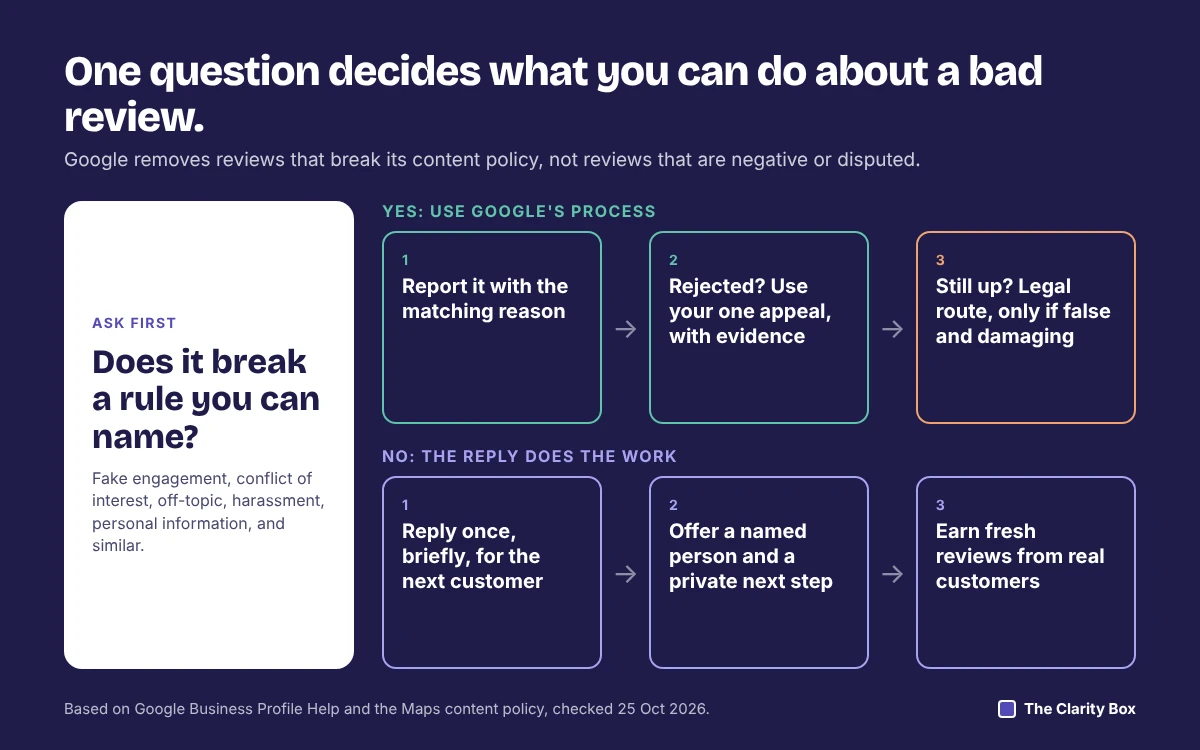
No. Google removes a review only if it breaks the Maps content policy, and its help page asks owners not to report reviews simply because they disagree with them (Google Business Profile Help). Google also says it does not take sides in disputes between a business and its customers.
So the job is not to prove the review is unfair. It is to show which rule it breaks. These are the categories in Google’s prohibited and restricted content policy that most often apply to reviews:
| Policy category | What it covers | A review that would qualify |
|---|---|---|
| Fake engagement | Reviews not based on a real experience, or paid for in money or in kind | A review from someone who was never a customer |
| Conflict of interest | Reviews from people with a business tie, including current or former employees and competitors | A former employee reviewing their old workplace |
| Off-topic | Content not about an experience at that place, including political or social commentary and personal rants | A rant about a news story that mentions your business |
| Harassment and offensive content | Threats, personal attacks, and unsubstantiated claims of unethical or criminal conduct | “The owner is a thief” with no experience described |
| Personal information | Someone’s personal details posted without consent | A staff member’s home address or phone number |
| Hate speech, obscenity, and profanity | Attacks on protected groups, and profanity used to insult | Slurs, or swearing aimed at a named person |
| Advertising and solicitation | Promotions, links, contact details, or social handles | A review that pushes a competitor’s website |
| Repetitive content | The same text posted several times, from one or several accounts | Five near-identical one-star reviews in a day |
Key point: a review is removable when you can name the rule it breaks. If you can’t, reporting it will rarely work.
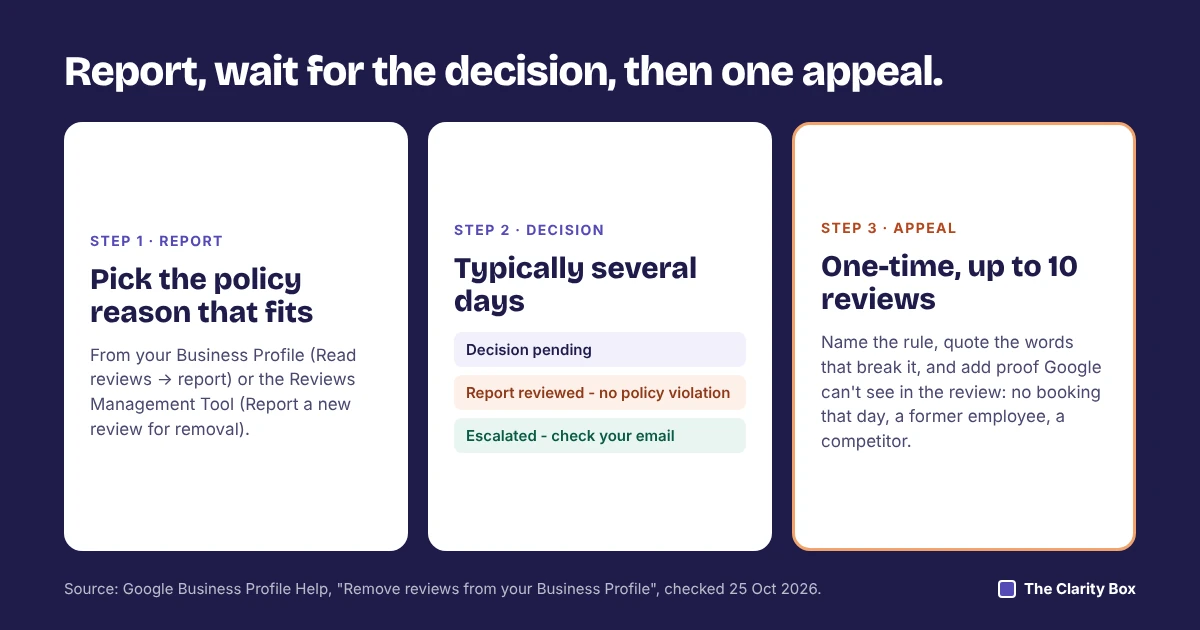
Report it from your Business Profile, or through Google’s Reviews Management Tool, and pick the policy reason that matches. Both routes are described on Google’s help page for removing reviews.
From your Business Profile
From the Reviews Management Tool
Before you report, write down three things: the date of the review, the exact wording that breaks the rule, and the category from the policy table. You will need them if you appeal.
One trap to avoid: asking staff, friends, or family to post positive reviews to balance it out. Reviews from people with a business tie fall under the same conflict-of-interest rule you are reporting, and they can put your own profile at risk. If that has already happened, our guide to Google Business Profile suspensions covers what usually triggers one.
Google assesses it, which its help page says typically takes several days, and the Reviews Management Tool shows the outcome. The statuses you will see are:
| Status in the tool | What it means | What to do next |
|---|---|---|
| Decision pending | Google has not finished assessing it | Wait for the decision, and keep your evidence ready |
| Report reviewed – no policy violation | Google decided the review stays | Appeal once, if you can point to a specific rule |
| Escalated – check your email for updates | The case has gone to further review | Watch the inbox of the account that manages the profile |
How to appeal: in the Reviews Management Tool, select Appeal eligible reviews, choose up to 10 reviews, select Submit an appeal, and complete the form. Google describes this as a one-time appeal, so make it count.
A strong appeal names the policy category, quotes the words that break it, and adds evidence a reviewer cannot see from the review alone. That might be a booking system showing no customer by that name on that date, or proof that the reviewer is a former employee or runs a competing business.
Key point: an appeal that says “this is false” usually fails. One that says “this breaks the conflict-of-interest rule, and here is the proof” gives Google something to act on.
In four common situations, reporting will almost never work, because nothing in the review breaks a rule Google enforces. Knowing them early saves you weeks of waiting on reports that come back “no policy violation”.
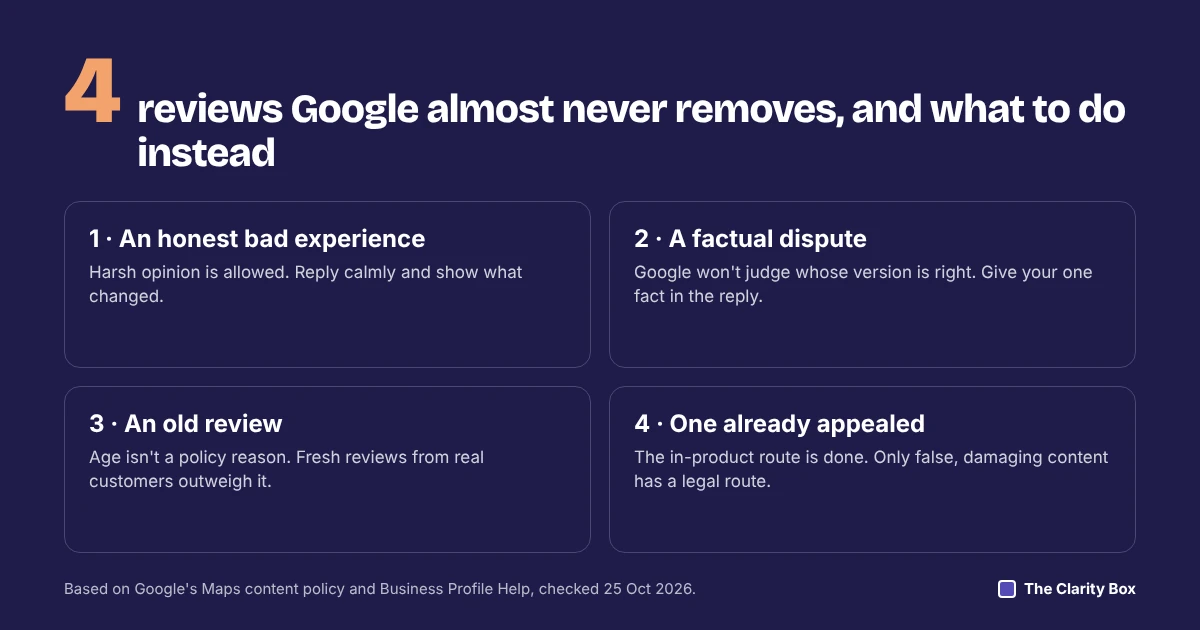
If a review fits one of these four, the most useful thing you can do is reply well and keep fresh reviews coming in from real customers. Readers weight recent reviews: in BrightLocal’s 2026 survey of 1,002 US adults, 74% said they look for reviews from the last three months (BrightLocal).
Reply once, briefly, and write for the next customer rather than the reviewer. People deciding whether to book read the complaint and your answer together, and a calm reply often does more for you than the removal would have.
A reply that works has four parts:
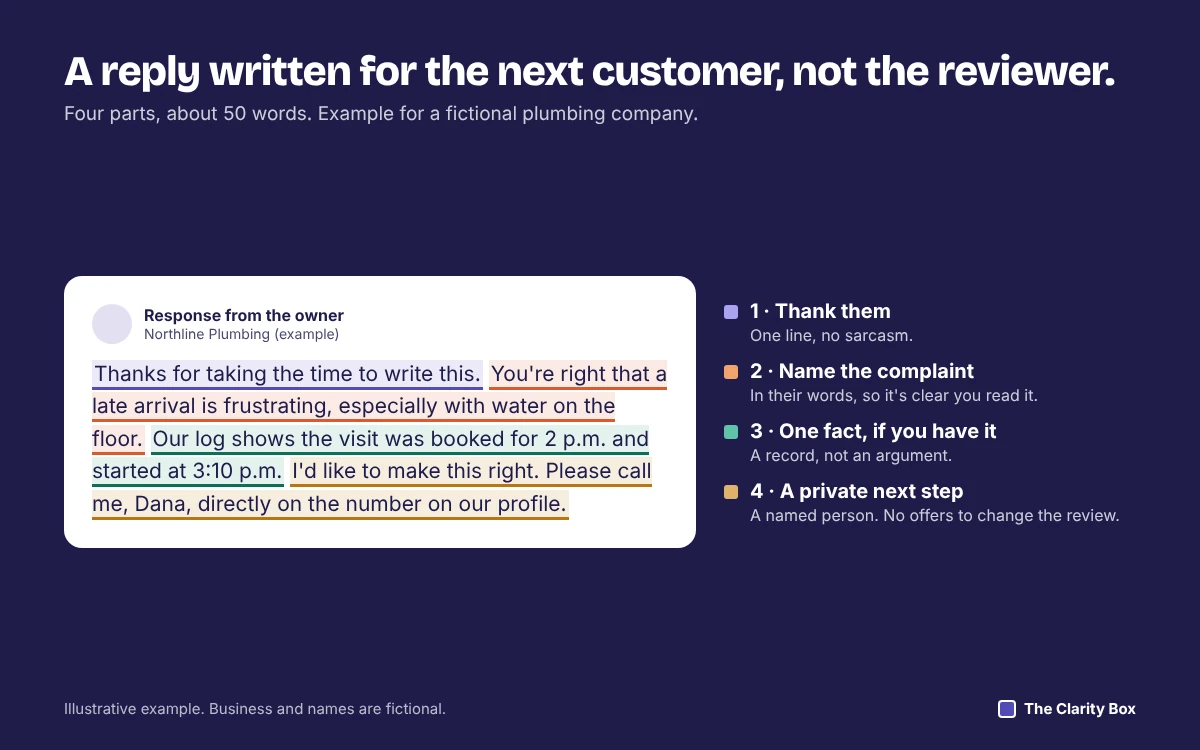
Three things to leave out: customer details the reviewer did not share, anything that reads as a threat, and an offer of money or a discount in exchange for changing the review. Incentives to revise or remove a review are banned under Google’s fake-engagement rule, and in the US, using groundless legal threats to remove a negative review is banned by the FTC’s 2024 rule on reviews.
Key point: you are not replying to win the argument. You are replying so the next reader trusts you more than the review.
Google’s policy and reporting steps are the same everywhere. What changes is the law behind them: which reviews are illegal, and what you can do when Google says a review stays. This section is general information, not legal advice. Speak to a lawyer where you operate before you threaten or start any action.
Everywhere: Google’s legal removal request. Separate from the policy report, Google takes requests to remove content that may break the law, through its legal removal help center. It asks you to flag the content in the product first, give the exact link, and explain what is unlawful and why.
| Country | Fake-review rules | If a review is false and damaging | Worth knowing |
|---|---|---|---|
| Canada | The Competition Bureau says fake or misleading reviews can breach the deceptive marketing provisions of the Competition Act, and that employees reviewing their employer must disclose the connection (Competition Bureau, January 2024) | Defamation is a matter of provincial law (civil law in Quebec). A court can order a platform to reveal who posted an anonymous review, which is known as a Norwich order | You can report a coordinated fake-review campaign against you to the Competition Bureau |
| United States | The FTC’s rule on consumer reviews, in force since 21 October 2024, bans fake reviews, undisclosed insider reviews, and buying reviews of a set sentiment (FTC, August 2024) | Claims are brought against the reviewer under state defamation law. Federal law generally shields Google itself from liability for what users post | The same FTC rule bans using groundless legal threats or intimidation to remove a genuine negative review |
| United Kingdom | Since 6 April 2025, the Digital Markets, Competition and Consumers Act 2024 bans fake reviews, concealed incentivized reviews, and suppressing negative ones, enforced by the CMA (CMS summary) | In England and Wales, a statement about a business that trades for profit is only defamatory if it causes, or is likely to cause, serious financial loss (Defamation Act 2013, section 1) | Scotland and Northern Ireland have their own defamation law |
Key point: in all three countries the law treats a harsh opinion very differently from a false statement of fact. Only the second gives you a legal route.
Reviews are one input to how a business shows up on the map. If you want the rest of your profile and rankings reviewed too, see our local SEO service or request a free SEO audit from The Clarity Box. Choosing who helps with your profile matters too: read the questions to ask before signing an SEO proposal.
Not on that basis alone. Google removes reviews that break its content policy, such as fake engagement, conflicts of interest, or harassment. If a false review comes from someone who was never a customer, report it as fake engagement and keep evidence that shows it.
Google's help page says assessing a report typically takes several days. It gives no timeframe for appeals. Track the status in the Reviews Management Tool.
Use the one-time appeal if you can name the rule the review breaks and add evidence. If the appeal fails, reply publicly and focus on earning new reviews. The legal route only fits content that is false and damaging.
Possibly. Defamation is handled under provincial law, and courts can order a platform to reveal who posted an anonymous review. It is slow and costly, so speak to a lawyer in your province before you threaten anything.
Google has not said, and we have not seen good evidence either way. Reply for the people reading the review, not for the algorithm.
Don't try it. Google's guidelines allow only one profile per business location, and a second profile for the same place breaks them (Business Profile guidelines). You would also lose the good reviews.
Share this article
Saba is an SEO and growth strategist with over 10 years of experience in SEO, content strategy, and digital marketing. She writes about organic growth, content optimization, technical SEO, and AI-powered search, translating complex concepts into practical, data-informed insights that help businesses make smarter marketing decisions.
Map calls dropped but the website didn't change? 11 causes outside your site, from suggested edits to spam listings, with...
Read MoreWhy Google suspends Business Profiles, what to fix first, and how to use your one appeal: the steps, the evidence...
Read MoreEvery AI search article quotes a different number. Here are 20, each traced to its study, with the sample, date,...
Read More